
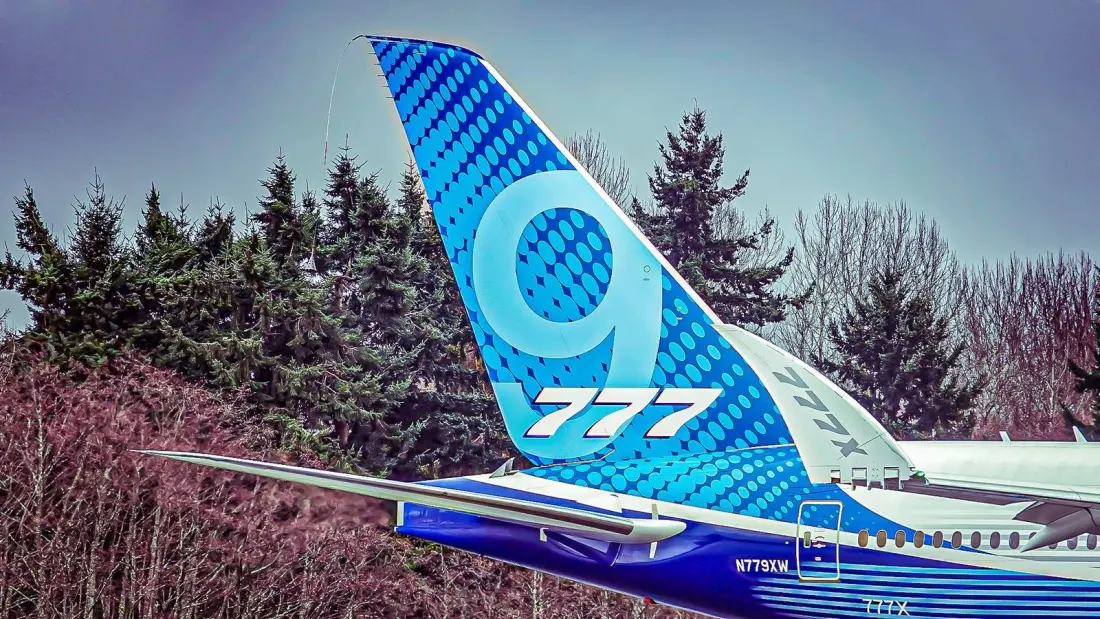
Boeing's long-delayed 777X has one feature no other commercial airliner has: wingtips that fold upward on the ground. At November's Dubai Airshow, a Boeing test pilot explained how they work from the cockpit — and the details are surprisingly practical rather than sci-fi.
For pilots, the wingtips are just another pre-departure item, checked like flaps via a switch on the overhead panel. The system escalates warnings if they aren't extended, with a takeoff rejection as the final failsafe. Once deployed, each tip is electronically isolated and secured by a large physical locking bolt, so there's no possibility of a fold in flight. After landing, the tips fold automatically once the aircraft slows to 50 knots — no extra pilot workload, and a narrower plane clearing the runway.
The whole idea exists because of the wings. To get the fuel efficiency and range it wants, the 777X carries enormous high-aspect-ratio wings spanning 71.75 metres in flight. That exceeds the limits of standard airport gates and taxiways, so folding the tips brings the ground footprint down to 64.85 metres — letting the jet use existing airport infrastructure without costly upgrades.
The family comes in two passenger versions: the 777-8, seating 395 in two classes with a standout range of 8,745 nautical miles, and the longer 777-9, with 426 seats and 7,285 nautical miles of range. Both fly GE9X engines. A 777-8F freighter carrying 112 tonnes is also in development. Boeing has 646 orders on the books, and nearly half come from a single airline: Emirates, with 270. Qatar Airways follows with 124, then Cathay Pacific, Singapore Airlines and Lufthansa.
Travellers shouldn't start planning around the 777X quite yet. First deliveries were once promised for 2020; the current target is early 2027, and the delays have cost Boeing around $15 billion. Airlines are adapting — Lufthansa is keeping its 747s flying longer, and Cathay has been waiting since 2013. Meanwhile, Emirates floated a stretched 777-10 with about 50 extra seats as a partial A380 replacement, though Boeing is still studying whether the longer fuselage can meet engine-out takeoff certification and whether demand beyond Emirates would justify the investment.
For anyone who flies long-haul, the 777X matters because it promises the capacity of a jumbo jet with better fuel economy — and its folded wings mean it can use the same airport gates as today's aircraft, so expect it to show up on familiar routes with Dubai, Doha and Frankfurt-based carriers first.