
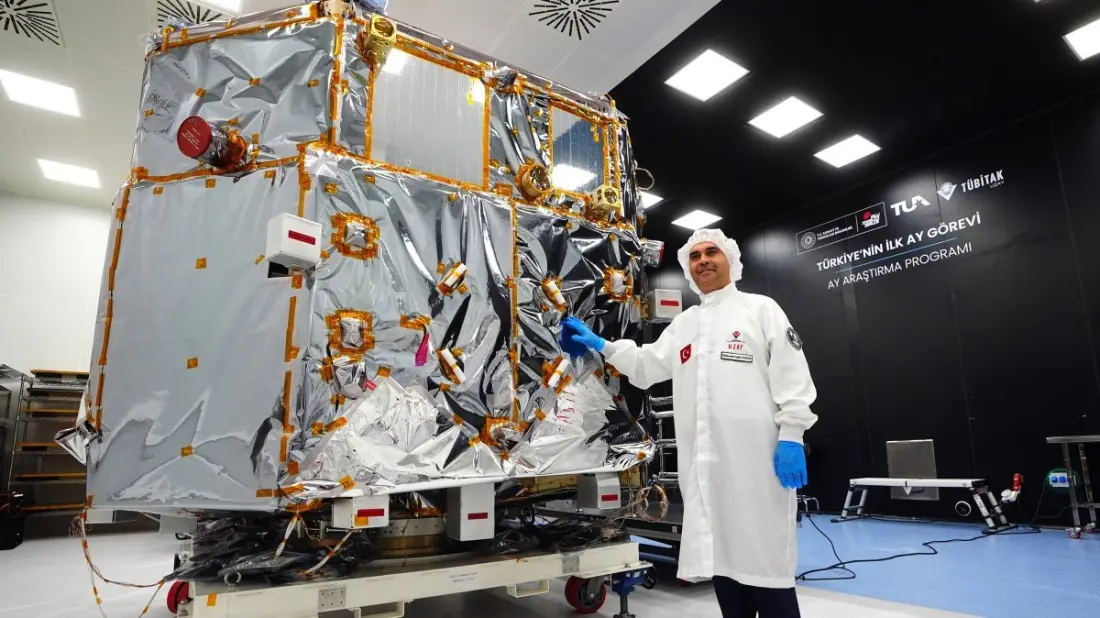
Türkiye has finished building the spacecraft for its debut lunar mission, and the timeline is ambitious. Industry and Technology Minister Mehmet Fatih Kacır announced that production, assembly and integration are complete, with the 3.5-tonne craft now at Turkish Aerospace Industries' Space Systems Integration and Test Center for environmental testing ahead of a launch window in the first months of 2027.
The plan reads like a statement of intent: after a two-month voyage, the spacecraft would settle into a polar orbit about 100 kilometres above the lunar surface, operating for at least three months with a possible extension to 18. Its science agenda covers solar wind interaction with the surface, how water forms on the Moon, magnetic fields, thermal properties and radiation measurement. When the science wraps up, Türkiye intends to steer the craft toward a controlled descent — a deliberate, fiery finale that would demonstrate deep-space manoeuvring. A domestically built hybrid propulsion system will handle orbit-raising and the final departure burn, firing in deep space for the first time.
More than 80% of the spacecraft is domestic content, built on know-how from earlier satellite programmes like Imece and Türksat 6A — flight computers, communications, power and thermal control all home-grown. The Moon Research Program, running since early 2022, is now 77% complete, with TÜBITAK UZAY, DeltaV and a cluster of Turkish startups involved. Once testing ends, the craft moves to a new clean room at TÜBITAK Space's METU campus in Ankara, then ships out for launch from Kennedy Space Center in the United States.
For anyone with even a passing interest in space, the timing is convenient: Türkiye signed the Artemis Accords on August 31, committing to peaceful, cooperative lunar exploration, and Antalya hosts the 77th International Astronautical Congress in early October, expected to draw nearly 10,000 participants from around the world. It's a rare chance to attend the world's biggest space gathering on the Turkish Riviera, with congress sessions running alongside a country positioning itself as a serious space player — including a planned space technology development zone in Ankara and a spaceport under construction in Somalia.
Why should a traveller care? If you work in or around the space sector, Antalya in October is the booking to make. Even for general visitors, Türkiye's push adds a new layer to trips there: the TÜBITAK and Turkish Space Agency ecosystem in Ankara may open up to public visits over time, and the country's satellite heritage — from Türksat 6A to this Moon shot — is becoming part of its modern identity. The broader takeaway is that Türkiye is treating space as an economic engine, not just a science project, and the next couple of years — from the Antalya congress to the 2027 launch — will be the stretch when that ambition becomes visible to the world.
The original report appeared in Daily Sabah Travel.