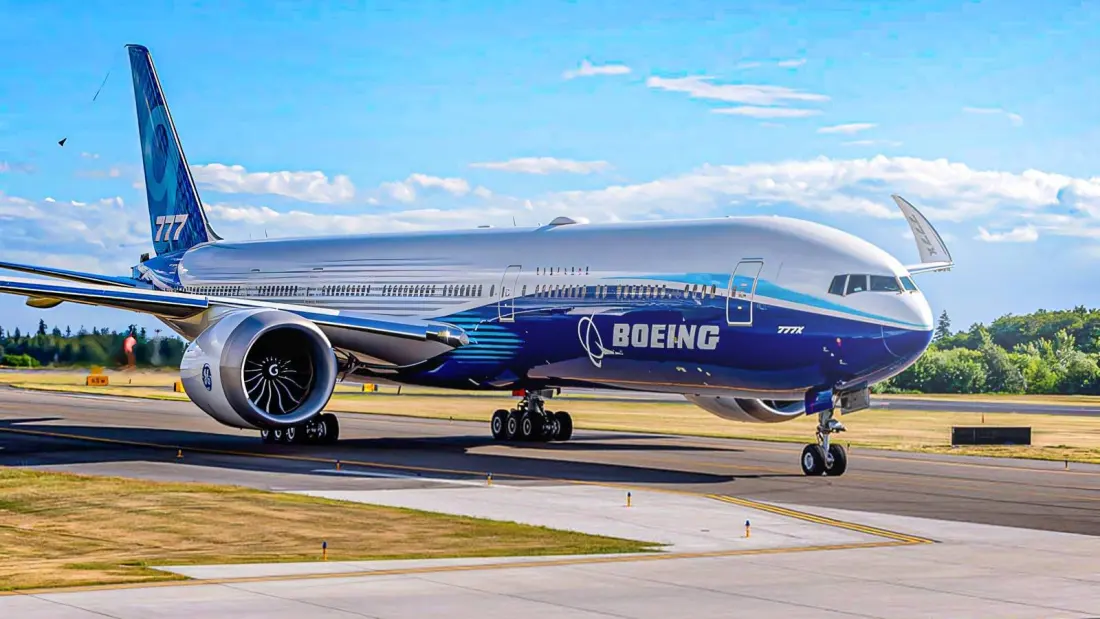
The Boeing 777X is supposed to be an evolution, not a revolution — a modernised take on the hugely successful 777 that saves development money by reusing a proven twin-engine formula. Yet one unusual feature, the folding wingtip, has ballooned into an engineering and certification challenge so complex that its cost reportedly rivals launching an entirely new aircraft.
The problem starts with wings. To hit ambitious fuel-burn and range targets, Boeing gave the 777X a vast carbon-composite wing with about 15% more surface area than before, delivering roughly a 10% efficiency gain over earlier models. In the air that wing spans 235 feet five inches (71.75 metres), which pushes the jet into ICAO Code F — the same bulky category that badly limited where the Airbus A380 could operate. Most major international airports are built around Code E: their gates, taxiways and hangars simply can't take a wider aircraft.
Boeing's fix was to make the outer section of each wingtip fold vertically upward on the ground, shrinking the footprint to 212 feet nine inches (64.85 metres) — small enough to use existing gates worldwide. It sounds simple, but nothing about it is. Cockpit displays show colour-coded wingtip status, and the fly-by-wire system will physically block takeoff thrust unless sensors confirm both hinge pins are fully extended and mechanically locked. In flight, the hydraulic and electrical circuits powering the folds are electronically isolated so no glitch or stray input can move them at cruise.
Landing is handled entirely by automation. As the jet decelerates through 50 knots, the computers trigger a 20-second retraction sequence, so the wingtips are fully vertical before the aircraft exits the runway. That timing is deliberate: fold too early and crosswinds could stress the vertical surfaces during the rollout; wait until a full stop and the widebody clogs an active runway at a busy hub.
The trade-offs are real. Hinges, actuators, locking bolts and backup sensors add weight and create maintenance work that older fixed-wing 777s never needed — hydraulic purity checks, actuator wear inspections, sensor calibration. If the system faults at a remote airport, the jet can't simply be dispatched with it deactivated; one stubborn bolt can ground the aircraft. Regulators responded with strict FAA special conditions, including proof that the folded tips can withstand ground winds above 65 knots without damage, and a latching design that stays secure even with total power loss.
Why should travellers care? The 777X promises quieter, more efficient long-haul flights that can use the same gates as today's widebodies — meaning more routes without airport rebuilds. The folding wingtip is the reason that promise is deliverable, and the reason the program has taken so long to certify. Next time you board one, those upright tips at the gate are doing far more work than they let on.