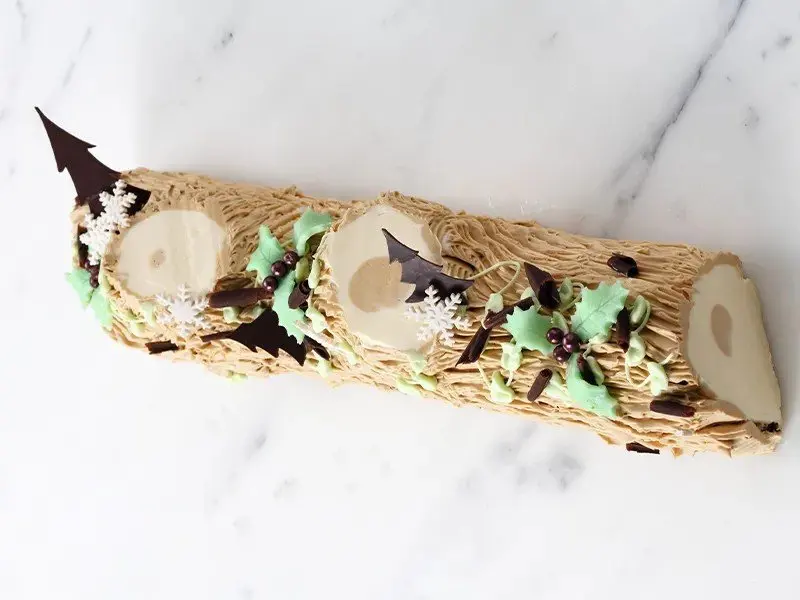
If your Christmas table needs a centrepiece, France already solved the problem: the Bûche de Noël, the log-shaped cake that has been a fixture of French holiday tables for generations. A recipe for the coffee version, published by The Good Life France, comes straight from the Ferrandi School of Culinary Arts in Paris — the prestigious training ground for many of France's top pastry chefs — and it's more approachable than the finished cake suggests.
The build has three parts. First a genoise sponge, whisked over heat until pale and ribbon-thick, then baked hot and fast (five minutes at 230°C) on a silicone mat. Second, a simple sugar syrup to soak the sponge so it stays moist. Third, the real workhorse: a coffee buttercream made by pouring hot sugar syrup cooked to 117°C into whisked eggs, then beating in a generous 325g of butter and flavouring it with coffee extract.
Assembly is where the log takes shape. Roll the syrup-brushed sponge up like a jelly roll, slice the ends at 45 degrees and perch them on top as the 'knots', then pipe the coffee buttercream in basketweave lines down the length. A fork dragged over the surface — dipped in ice-cold water — gives you the bark texture, and a warmed knife smooths the cut ends. The finishing touch is plain buttercream tinted green and piped as ivy winding along the log, with optional holly, fir trees or snowflakes.
Two practical points worth noting. It serves six to eight and takes roughly two hours of active work, but the finished cake keeps up to a week in the fridge — so you can make it well before Christmas Day and cross dessert off the list early. The recipe is extracted from French Pâtisserie: Master Recipes and Techniques from the Ferrandi School of Culinary Arts (Flammarion, £45), a hefty reference if you want to go further into French pastry.
Who is this for? Anyone spending the holidays in France will see bûches everywhere — pâtisseries compete with mirrored glazes, chestnut versions and wildly modern designs each December — and this is your chance to understand what you're eating, then recreate it at home. It also suits travellers planning a festive trip to Paris or a French Christmas market: knowing the bûche tradition adds context to window displays and restaurant menus. And if you're hosting instead of travelling, it's a genuinely impressive dessert that costs a fraction of a pâtisserie version.
The recipe, method and timings all come from Ferrandi via The Good Life France; the only equipment you might not already own is a basketweave piping tip, an instant-read thermometer and a stand mixer — or patience with a hand beater.