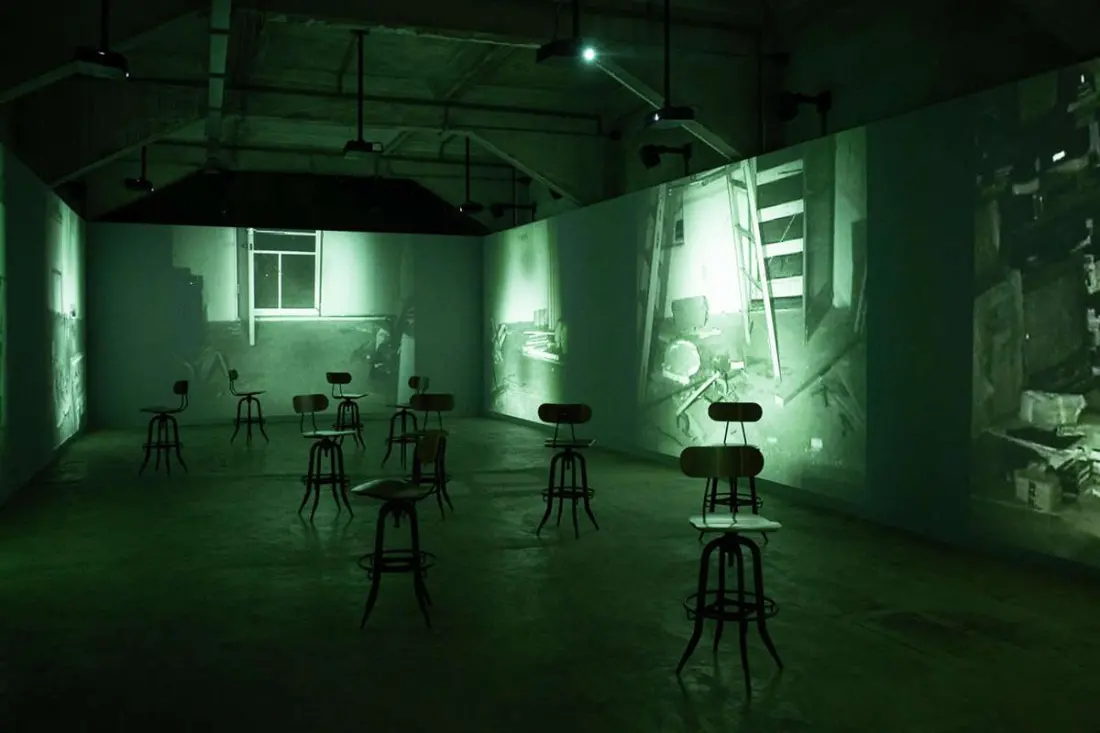
A mouse skitters across the dark floor of an empty artist's studio in New Mexico. A moth drifts past the lens. A cat stalks through the black. Until early April, that footage — projected across seven black-and-white screens in Bangkok — is the closest most of us will get to stepping inside the mind of Bruce Nauman, one of the most influential American artists of the postwar era.
The work, Mapping the Studio I (Fat Chance John Cage) from 2001, is currently on view at Bangkok Kunsthalle, thanks to a collaboration with the Dia Art Foundation and a private art foundation. It's a rare chance to see a major Nauman installation in Southeast Asia, where his work seldom travels.
The piece grew out of a very simple irritation. Nauman, born in Indiana in 1941, kept noticing mice in his studio near Galisteo, New Mexico. Instead of setting traps, he set up infrared cameras and pointed them at the corners of the room. Every night, while he was somewhere else, the machines recorded whatever happened in the space: vermin wandering, moths fluttering, ambient sounds swelling in the dark. The resulting installation pairs those grainy night recordings with multiple channels of sound, spread across seven projections.
There's a wink in the subtitle. Composer John Cage famously framed silence as content — 4'33" asks audiences to hear the sounds of a quiet room. Nauman, who earned an MFA at the University of California, Davis, in 1966 after a science degree at the University of Wisconsin-Madison, turns that proposition on its head. His studio is never truly empty, and its silence is never really silent. Things keep happening without him.
That idea has driven Nauman's practice for more than six decades, spanning sculpture, video, performance, sound, drawing and installations. Early in his career he asked a deceptively simple question: what does an artist actually do when alone in the studio? His conclusion was radical. Whatever he did in there — pacing, thinking, making noise, or nothing at all — counted as the art. "If I was an artist and I was in the studio, then whatever I was doing in the studio must be art," he noted. The studio became less a factory for finished objects than a laboratory where ideas get tested.
For travellers passing through Bangkok, this is a genuinely worthwhile detour. Bangkok Kunsthalle has been building a reputation for staging serious international contemporary art alongside Thai work, and hosting a Nauman of this scale puts the city on the regional art map. Even if contemporary art isn't usually your thing, the installation is accessible in the best sense: dark rooms, flickering screens, the small dramas of nocturnal animals. No art-historical homework required, though knowing the backstory makes it richer.
The show runs until April 4, so visitors to Thailand this season have a clear window. Pair it with Bangkok's other galleries and the riverside creative districts, and you've got the makings of a culture-heavy city break that goes well beyond temples and street food.