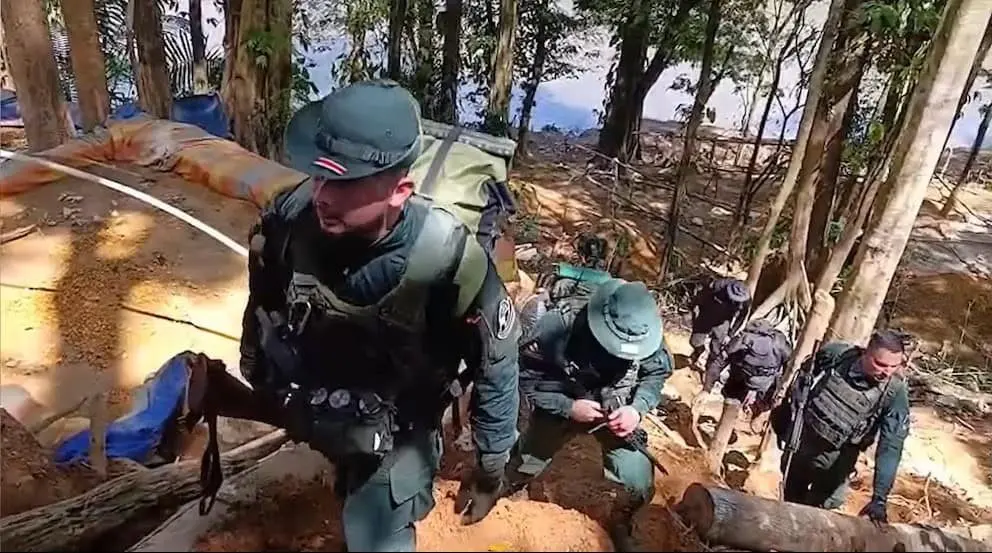
On a steep hill called Cerro Conchuditas, close to the San Juan River that marks the border with Nicaragua, Costa Rican police have been dismantling one of the country's biggest illegal gold-mining sites. Since Thursday, officers backed by US-government helicopters have found roughly 2,000 sacks of gold-bearing sediment, 50 processing pools, 20 makeshift shelters and a cache of equipment including generators, water pumps, rotary hammers and fuel cans.
The operation is a joint effort between the Public Force, Border Police, Migration Police and the intelligence directorate DIS, with air support from helicopters supplied through a US State Department aviation program. Costa Rica's air wing received four UH-1ST helicopters from the United States in 2019, and much of this terrain is unreachable on foot, which is why flights are essential. Security Minister Gerald Campos travelled to the site personally to direct the deployment.
Police have since pushed on to nearby Cerro Fortuna in Crucitas, where they found active extraction points and detained three men accused of illegal mining. The wider numbers are striking: 528 arrests connected to these operations so far in 2026, including 239 for immigration violations and 194 under the Mining Code.
Why does a remote hill matter to travellers? The Crucitas zone sits in San Carlos, in the northern lowlands of Alajuela province — the same canton that draws visitors to La Fortuna and the Arenal Volcano area further south. The mining itself happens in a sparsely visited border corridor, well away from tourist routes, so there's no direct risk to typical itineraries. The bigger story is environmental: police report that sediment here is processed with mercury and cyanide, and in May they seized 110 pounds of cyanide from a camp on the same hill. Runoff drains toward the San Juan River, which flows into the Caribbean — a concern for anyone who cares about the rivers and wetlands that make northern Costa Rica worth visiting.
There's a political fight brewing, too. Campos has urged legislators to pass a 2024 bill that would authorize open-pit gold exploration in Cutris, arguing current laws leave police running in circles. Opposition parties counter that reopening Crucitas to legal mining would cause its own environmental damage — a debate travellers who love Costa Rica's reputation for conservation should watch.
Officers will remain on Cerro Conchuditas and in the surrounding Crucitas area searching for more processing sites. For now, the message for visitors is simple: the popular Arenal and San Carlos highlights are unaffected, but the remote border wetlands near the San Juan are best experienced with local guides rather than independent exploration.
The Tico Times