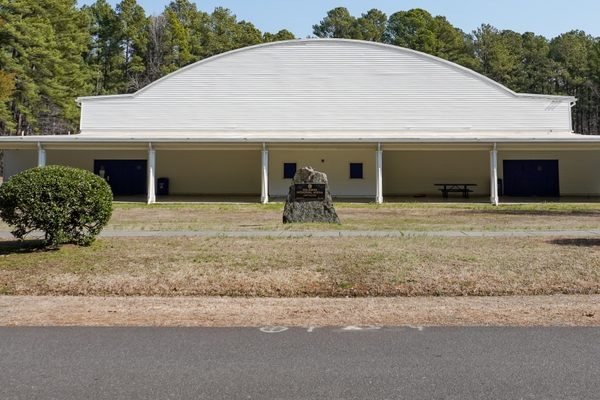
In 1942, a military city the size of a small town appeared almost overnight on more than 40,000 acres of North Carolina farmland. Camp Butner, built in a matter of months after 250 families across three counties received eviction notices in January of that year, eventually held nearly 1,800 buildings — and by the end of the decade, most of it had simply been unbolted, jacked onto trailers and hauled away.
The museum in Butner preserves what remains of that story. More than 250,000 troops trained there between 1942 and 1946, including the 78th "Lightning" Infantry Division, activated on-site in August 1942, which later fought at Kesternich and crossed the Rhine at Remagen. The camp also held thousands of German and Italian prisoners of war from September 1943 onward.
What makes the place unusual is how thoroughly it disappeared. After the War Department declared the base inactive in January 1946 and excess in 1947, the newly evacuated town — built to support 40,000 people — opened to civilians. Some land went back to its original owners. Because the temporary buildings sat on concrete piers, residents could loosen the bolts, jack up a structure onto a trailer and take it home. Much of the town was dismantled this way, and the forest has been reclaiming the rest ever since.
Inside the museum you'll find uniforms, maps, personal effects and archaeological fragments pulled from the old grounds, telling the intertwined stories of soldiers, prisoners and the farming families who lost their land. Two of the curators were among the original 1947 residents of the civilian town of Butner, which gives the place an unusually personal curatorial voice.
For travellers, the appeal is specific: this is WWII home-front history at a human scale, ideal for anyone researching a relative's wartime unit or simply curious about how quickly America built — and then erased — an entire military installation. It also makes a straightforward day trip, with restaurants nearby in town.