
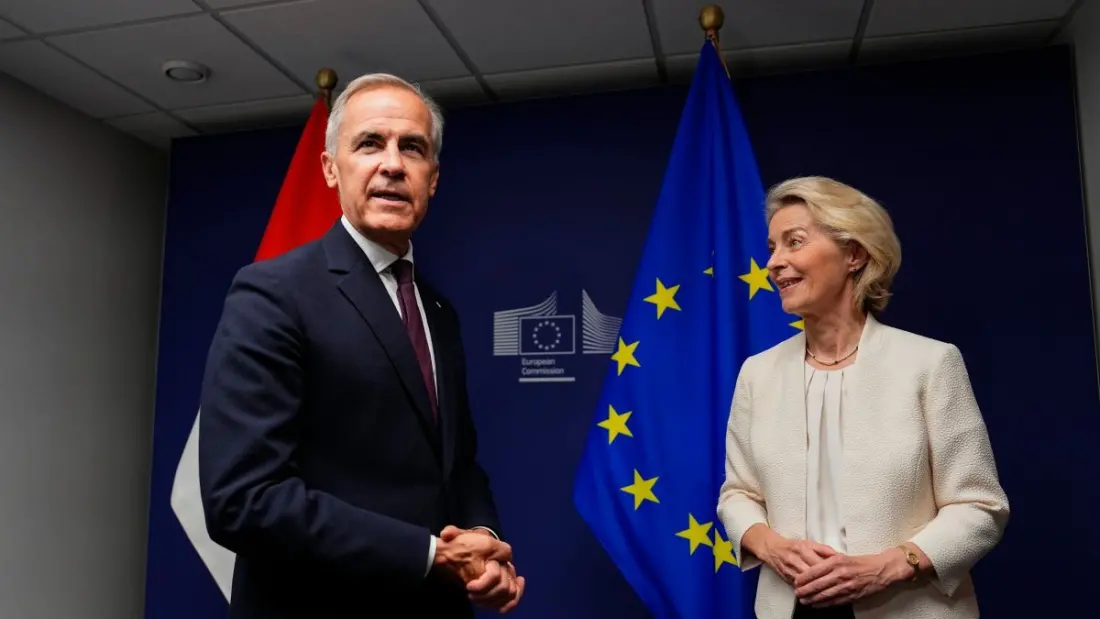
European Commission President Ursula von der Leyen surprised the European Parliament in Strasbourg by proposing Canada as the EU's first-ever "associate member" — a status the bloc has never granted anyone and which has no legal definition yet. The announcement came during her annual State of the Union address on 16 September, where MEPs gave her a standing ovation before she embraced Canadian Prime Minister Mark Carney, who was in the chamber to hear it.
The pitch is framed around geopolitics rather than tourism: von der Leyen described an "openly hostile world" shaped by Russia's war in Ukraine, trade friction with the US administration and rivalry with China. She argued Europe and Canada "see the world with the same eyes," pointing to shared positions on AI, climate change, the Arctic, defence and supply chains. Concrete ideas include a tech alliance, joint work on intelligent manufacturing, integrated defence industrial bases and making the Arctic a "flagship joint project."
Don't book anything around it just yet. The proposal needs EU member states to sign on, and they've been cool toward similar ideas — Germany's May suggestion of associate membership for Ukraine met a lukewarm response. One EU diplomat told Reuters "nobody really knows what it means," and voiced concern that von der Leyen may be over-promising. Carney himself has said Canada wants a "unique alliance" with the EU, not membership, with detailed talks set for the Canada-EU summit in Montreal in late October.
Still, the direction of travel is real. The push follows Canada's worst rift with the US in decades — trade talks collapsed in August, triggering tit-for-tat tariffs — and Ottawa has pledged to double its non-US trade within a decade. Deeper EU-Canada collaboration on trade, defence and digital security is already being explored by officials on both sides.
Why should holidaymakers care? Closer ties could eventually mean smoother travel and business links across the Atlantic: think expanded air routes, easier mobility for workers and students, and joint projects that open up places like the Canadian Arctic to European visitors and investment. Canada is already an easy long-haul trip for EU passport holders — visa-free for short stays — and a weak moment for US-Canada relations has nudged Canadian destinations to court European travellers more actively. For now, treat the associate-membership talk as a signal of where things are heading, not a change to your booking. If anything, it's a nudge to look beyond the usual Toronto-Montreal-Vancouver circuit: Quebec City, the Maritime provinces and the northern territories all stand to gain from closer European links. Details from Reuters via Daily Sabah Travel.