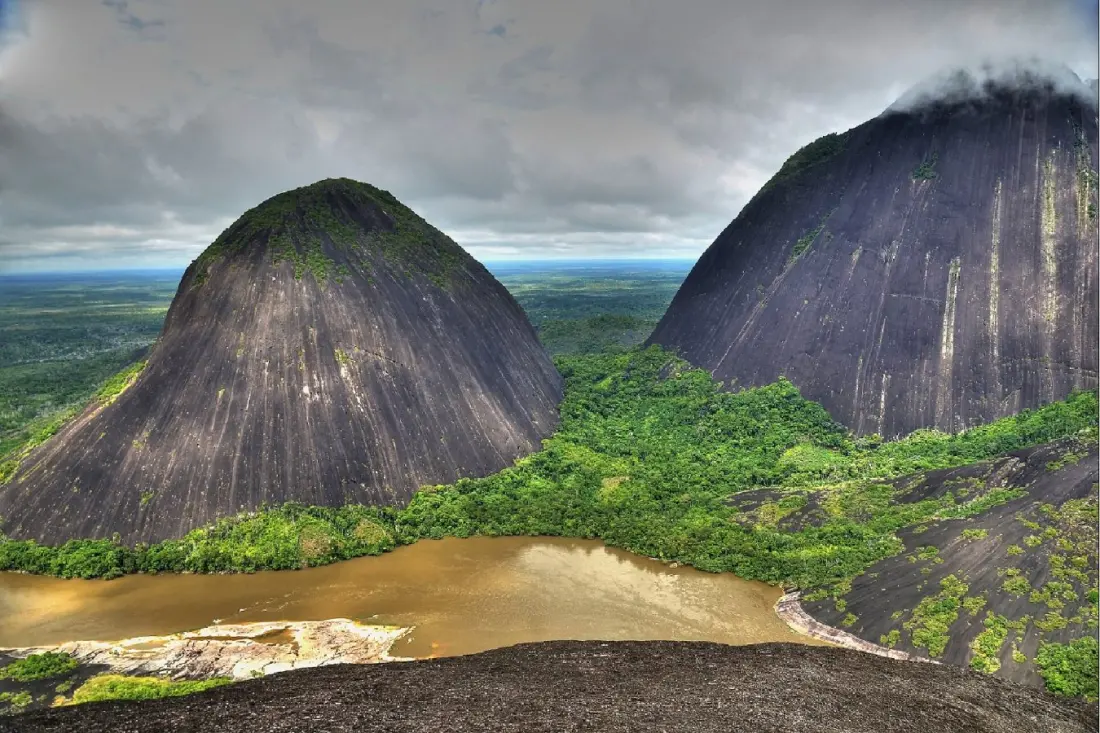
Everyone chasing Colombia's famous hikes heads to the Lost City or the high Andes of Los Nevados. But out east, where the country melts into savanna and jungle along the Venezuelan border, a very different adventure is drawing a slow trickle of travellers: the Cerros de Mavecure, three enormous granite monoliths rising straight out of the rainforest in the remote department of Guainia.
The three domes — Mavecure, Mono and Pajarito — are estimated at over 1.2 billion years old, placing them among the oldest exposed rock formations on the planet. They shoot up from an otherwise flat Orinoquia landscape of rivers, forest and open plains, a region so water-rich that fresh water reserves are reckoned at three or four times those of Europe. Mass tourism hasn't found it yet, largely because getting there takes effort: a flight from Bogota to Inirida, then a boat ride up the Inirida River.
The summit hike is steep but not technical, taking one to two hours depending on conditions and fitness. The trail starts in dense jungle before turning into bare, exposed granite that gets slick in the rain — proper hiking shoes are non-negotiable. At the top, the payoff is a 360-degree panorama of unbroken rainforest threaded by rivers, with the neighbouring domes punching through the canopy. Sunrise is the classic time to go, when mist hangs over the jungle before the sun lights up the rock.
The trip is as much cultural as it is physical. Guainia is home to Puinave, Curripaco and Tucano communities, and much of the tourism here is community-led — guides explain the mountains' spiritual weight in Indigenous cosmology, and visitor spending goes directly into local hands, helping protect both heritage and ecosystem.
The region's rivers add a second string to the bow. Several waterways offer Category III and IV whitewater, runnable for fit beginners and intermediate paddlers with professional operators providing gear and trained guides. Unlike the established rafting hub of San Gil in Santander, these eastern runs see almost no international visitors — one of the last genuinely quiet adventure corners in South America.
Who's it for? Travellers who've done the Lost City, want empty trails rather than queues, and are happy trading convenience for solitude. Go in the December-to-March dry season for firmer trails, reliable boat transfers and clearer views; the wetter months bring lusher forest and shifting river scenery. Year-round it's hot, so pack light clothing, sun protection and plenty of water — and travel with local guides, respect community customs and pack out your waste so this place stays as wild as it is now.