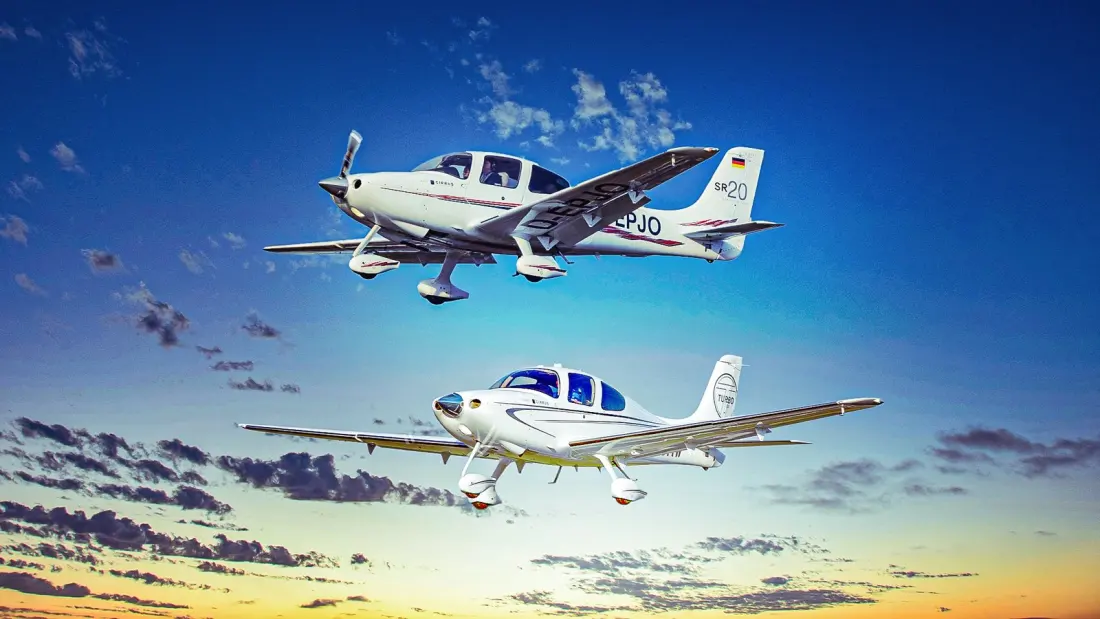
On paper, the Cirrus SR20 and SR22 look like siblings with different badges. Same composite airframe, same glass cockpit, same whole-aircraft parachute system, same 49-inch-wide cabin. But the numbers underneath tell a story of two very different aeroplanes, and the gap between them matters whether you're a private pilot weighing a purchase or just curious about what modern light aircraft can do.
The headline difference is the engine. The SR20 runs a 215-hp Lycoming IO-390-C3B6; the SR22 gets a 310-hp Continental IO-550-N — roughly 44% more power. That translates into a cruise speed of 183 knots for the SR22 versus 155 for the SR20, a maximum range of 1,169 nautical miles against 709, and a much shorter takeoff roll (1,082 feet compared with 1,685). Climb performance separates them further: the SR22 manages 1,270 feet per minute against the SR20's 781, which counts for a lot at high-altitude airports, in hot weather, or in mountainous terrain. Useful load differs too — 1,328 lb for the SR22 versus 1,003 lb for the SR20 — so the bigger model carries more people, fuel and bags on genuinely long trips.
The SR20 isn't a stripped-out version, though. It keeps the CAPS ballistic parachute, modern avionics and the same cabin dimensions, and it has earned professional credibility: Cirrus built its TRAC20 trainer on the platform and supplies SR20s to United Aviate Academy. For pilots flying short recreational trips with one or two passengers, paying for 310 hp may simply be wasted money.
Money is where the split sharpens. Cirrus's 2026 North American price list puts a new SR20 Premium at $754,900 and an SR22 at $937,900 — an $183,000 gap. The used market is messier: average SR20 asking prices range from about $288,000 to $366,000 depending on generation, while SR22s average around $574,000. Because these models have spanned many generations (G2 through G7), two aircraft with the same name can differ enormously in avionics, condition and CAPS status, so buyers need to compare specific aeroplanes, not model badges.
There are alternatives worth knowing. The Cessna 182 Skylane is slower (145 knots) but conventional and practical, with used examples averaging around $289,000. The Beechcraft Bonanza G36 competes with the SR22 but lacks the Cirrus parachute as standard. The out-of-production Cessna TTx is seriously quick at 235 knots, while Van's RV-10 — an experimental kitplane — matched the SR22's speed in AOPA's fly-off test at a fraction of the cost, completed aircraft running roughly $325,000 to $495,000.
The bottom line: pick the SR20 if your flying is local, short and lightly loaded, and the SR22 if you regularly fly cross-country with full seats. And if budget is the deciding factor, the experimental route offers a provocative third option — though it's a very different kind of ownership.