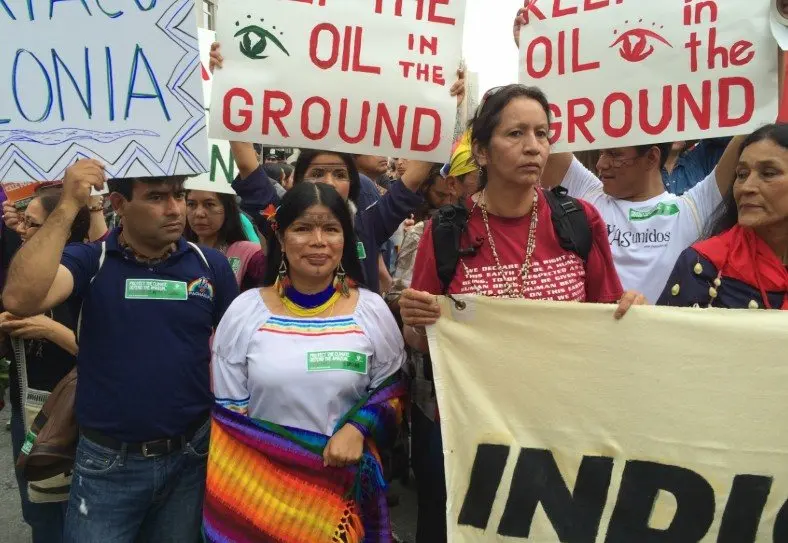
Ecuador's government has announced plans for a major new oil auction in the Amazon, and the reaction from Indigenous organisations has been swift and blunt: not here, not again.
At the Annual Oil and Gas Summit in Quito, officials under President Daniel Noboa unveiled what's being called the "Optimization and Exploration Round." It would open 14 oil blocks in the remote southern rainforest near the Peruvian border, put 11 northern fields held by state company Petroecuador on the table, and target Pungarayacu — a huge extra-heavy crude field in the central Amazon. The auction launches in December 2026, with contracts expected to be signed by the end of 2027. The government hopes to attract billions in investment and eventually produce up to 300,000 barrels a day from the new southern blocks alone.
The problem? These are some of the most contested blocks in the entire Amazon. The southern concessions overlap the titled territories of seven Indigenous nations — the Achuar, Andoa, Kichwa, Sapara, Shiwiar, Shuar, and Waorani — none of whom have been consulted, and all of whom reject the plans outright. There's a three-decade track record here: since the 8th Oil Round in 1995, every attempt to drill this region has collapsed. Texan company ARCO, then Burlington, then ConocoPhillips all failed to advance projects in Shuar and Achuar territory. The Kichwa of Sarayaku forced out Argentina's CGC and won a landmark ruling at the Inter-American Human Rights Court on the right to consent. The 11th Oil Round in 2012 was scrapped after protests in Quito, Houston, Paris and Calgary. And in 2014, Canada's Ivanhoe Energy abandoned the Pungarayacu field after years of resistance from the Kichwa of Rucullacta, whose lands sit near Sumaco Napo-Galeras National Park and the headwaters of the Napo River.
For travellers, this matters because the southern Ecuadorian Amazon is one of the most intact and culturally rich rainforest regions on the continent — a place people visit precisely because communities like the Sapara and Achuar have kept extraction out. Community-owned lodges and guided experiences in places like Pastaza and Morona Santiago depend on that standing. Campaigners argue the auction threatens the rivers, forests and Indigenous cultures that make the region worth visiting, and note that global oil demand is forecast to peak around 2032 anyway. Whether this round goes the way of its predecessors — nowhere — is a story anyone dreaming of Ecuador's rainforest should keep an eye on.
Credit: Cuenca High Life