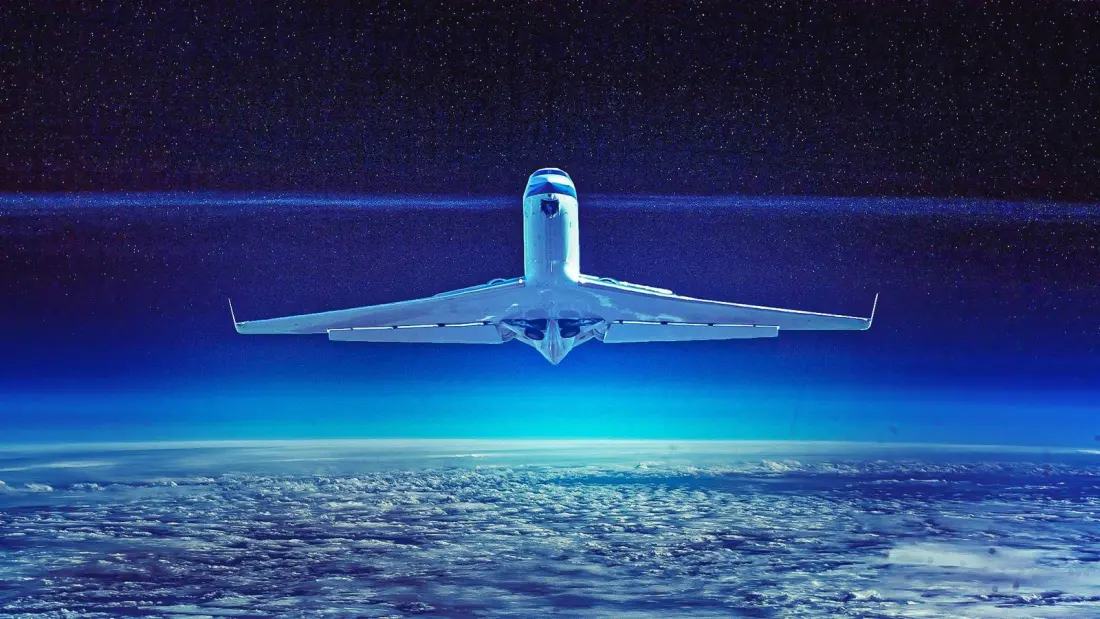
Cruise altitude on a long-haul flight is sold as the smoothest part of the trip, but up around 40,000 feet aircraft are operating close to several hard physical limits at once. Pilots have a name for the most uncomfortable version of this: coffin corner, also called Q corner — the altitude band where the safe speed range shrinks to almost nothing.
Here's the basic problem. As you climb, the air gets thinner, so a plane must fly faster (in true airspeed terms) to generate enough lift. But the speed of sound also drops as the air cools, so shock waves start forming over the wings at lower and lower speeds. Eventually the two boundaries nearly meet. Fly a few knots too slowly and the wing stalls; a few knots too fast and you hit Mach buffet. Near the service ceiling, that gap can be razor thin — the legendary U-2 spy plane reportedly flew at 60,000 feet with as little as six knots between stall and Mach buffet. Airliners keep far healthier margins, but the principle scales.
Weight matters too. A heavy aircraft stalls at a higher speed, which pulls coffin corner closer. That's one reason long-haul flights use step climbs — cruising lower at first, then creeping higher as fuel burns off and the plane lightens. Even routine flying gets delicate up there. A shallow banked turn increases the load on the wings, which raises stall speed; speeding up to compensate risks the Mach side. Control surfaces also bite less in thin air, so abrupt inputs have outsized effects. High-altitude upset recovery training hammers the same lesson: be smooth, manage energy, don't yank.
The invisible wildcard is clear air turbulence, or CAT. Unlike storm turbulence, it happens in cloudless sky, so onboard weather radar — which needs moisture to reflect — can't see it coming. It's most common between roughly 20,000 and 45,000 feet, exactly where jets cruise, and tends to form near jet streams and mountain waves. Crews lean on forecasts and reports from aircraft ahead. At normal cruise a nasty CAT encounter means spilled drinks; near coffin corner, a sudden vertical gust can shift the wing's angle of attack fast enough to trigger buffet on either boundary. A small altitude change often restores a comfortable margin, which is why pilots take turbulence avoidance so seriously.
Then there's the human body. Above 40,000 feet, pressurization isn't a comfort feature — it's life support. After a rapid decompression at 35,000 feet, useful consciousness can last under a minute, and less higher up. Hypoxia's early symptoms are sneaky: lightheadedness, mild euphoria, slipping concentration. That's why pilots do altitude chamber training to learn their personal warning signs, and why cockpit oxygen masks are built to don in seconds. The standard response is an immediate emergency descent to breathable air.
Why should a traveller care? Mostly for reassurance: everything here is why high-altitude flying is so safe. Manufacturers set maximum altitudes conservatively, flight manuals include buffet charts, autothrottle systems hold speeds with precision, and pilots rehearse decompression and upset scenarios in simulators. Airlines don't fly high because they can — they fly at the altitude where weight, temperature, turbulence forecasts and fuel burn all balance. If your flight steps up to 41,000 feet mid-route, that's not showing off; it's careful margin management. Source: Simple Flying.