If long hikes leave your lower back aching, the problem probably isn't the trail — it's how you're stacked on top of it. Trainers Marc Monroe and Steve Brown, writing via Backpacker, compare posture to your car's alignment: a slight tilt is fine over a few blocks, but pile on trail miles and a 30-40 pound pack, and the wear shows up fast in your neck, thoracic spine, hips and lower back. Left alone, sloppy alignment can snowball into chronic issues like IT band syndrome or disc problems.
Brown's go-to image is a snowman: stacked snowballs need to sit directly on top of each other, and one leaning forward wrecks the whole structure. Same with your body. The cue many coaches use is a string running through your knees, hips, spine and head, pulling straight up — chest out, chin tucked, ribs over hips, pelvis level. Keep your lower back neutral (neither arched nor rounded), which usually means lightly squeezing your abs, especially under load. And stop staring at your boots; look 10-15 feet up the trail so your neck isn't cranked down for hours.
Before you blame your body, though, check your pack. Monroe calls poor pack fit the number-one cause of bad hiking posture. A properly fastened hip belt should carry 70-80 percent of the weight; if it doesn't, the pack slides, your upper back rounds, your chin juts forward, and your shoulders pick up the slack — the slouch your mother warned about, multiplied by 40 pounds. Packing matters too: all the weight at the bottom pulls you backward, all at the top tips you forward. Aim for weight balanced close to your spine.
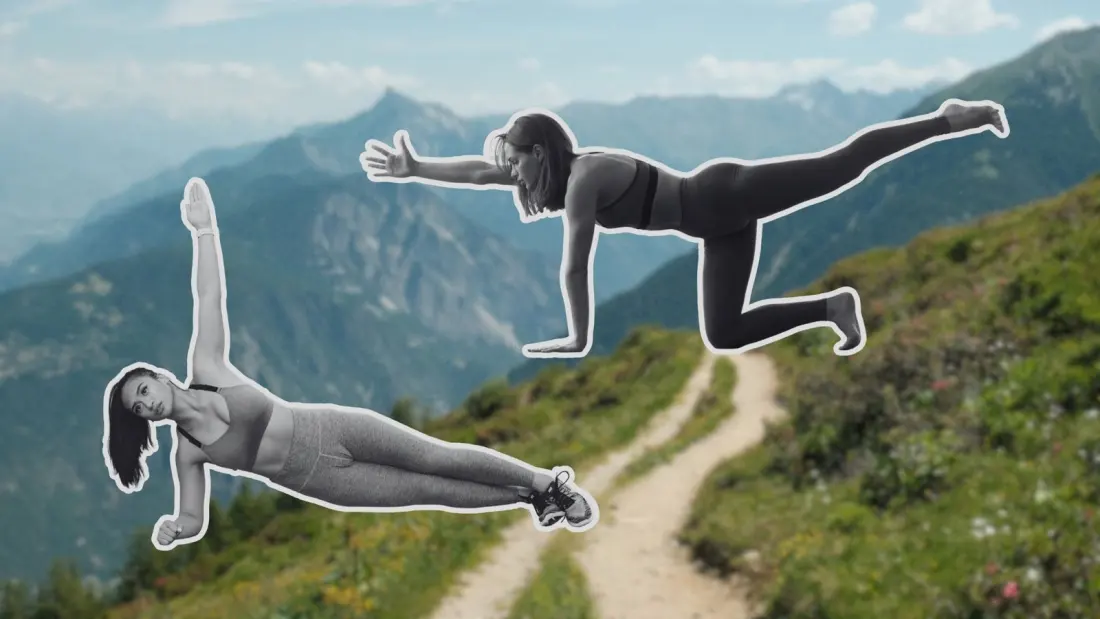
If the fit is right and you still hurt, the culprit is core stability — and Monroe means the whole trunk, not just abs: traps, rhomboids, rotator cuffs, glutes. In hikers these muscles are often underdeveloped, so no amount of "stand up straight" self-talk works when the endurance isn't there. His prescription: two gym sessions a week for six to eight weeks before a big trip, built around eight moves — lat pull-downs and prone dumbbell raises for the upper back; dead bugs and bird dogs for deep core; hip hinges, side planks, suitcase carries (work up to a dumbbell roughly equal to your pack weight) and Pallof presses for anti-rotation strength. Most are three sets of 6-10 reps, no exotic equipment needed.
Why it matters for travellers: a backpacking trip you've spent months planning can be quietly undone by preventable back pain. A couple of months of targeted prep, plus a properly fitted pack and smarter packing, is a far cheaper fix than cutting a trek short. It's for anyone carrying a load on foot — from first-time hikers to trekkers eyeing multi-day routes.