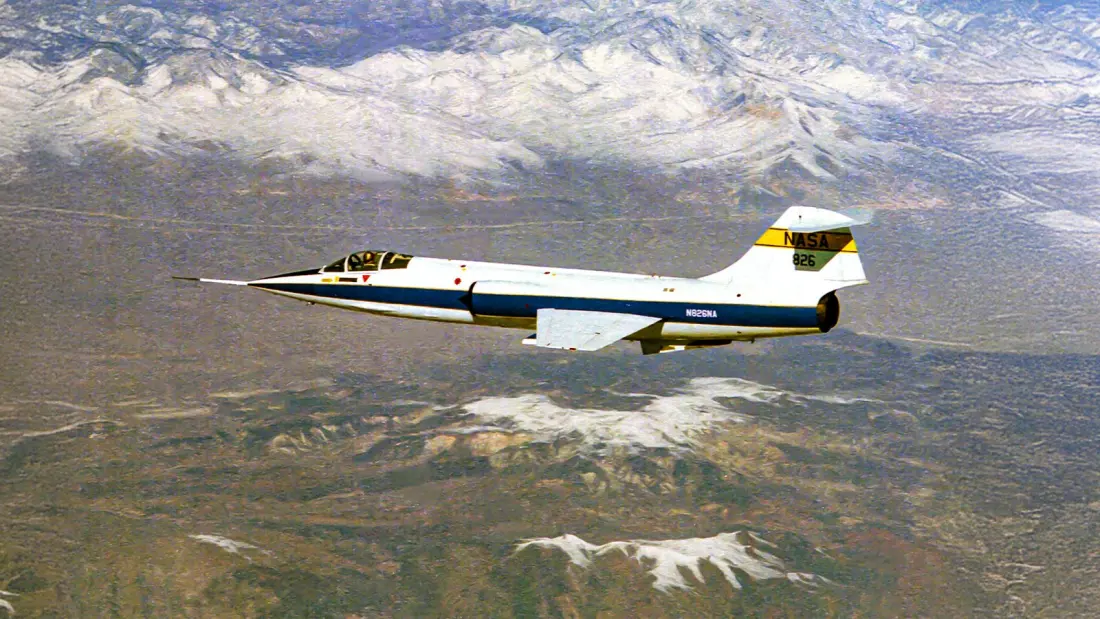
Park beside the old Space Shuttle runway at Kennedy Space Center and you'll find one of aviation's strangest tenants: the world's only civilian fleet of flight-ready Lockheed F-104 Starfighters, kept airborne by a Florida company with its sights set on space.
Starfighters Space began in the mid-1990s, when former Navy and airline pilot Rick Svetkoff wanted to fly the slim, needle-nosed interceptor at airshows. The plan changed. After moving to Kennedy Space Center in 2007, the company signed a Space Act Agreement with NASA and found steadier work flying supersonic research missions. In 2011, five F-104s bought from the Italian Air Force gave the fleet its current shape.
The jets are ideal testbeds because they climb and accelerate much like a rocket's first stage. A single flight can expose customer payloads to over ten minutes of sustained Mach 2+ conditions through a modular underwing pylon system the company calls a 'Wind Tunnel in the Sky'. Clients have included the US Air Force Research Laboratory and Lockheed Martin, and in 2025 one of the jets carried GE Aerospace's ATLAS propulsion test vehicle on three supersonic flights, validating technology for future hypersonic programs. The fleet also pulls steep parabolic climbs that deliver 60 to 90 seconds of microgravity per run, useful for testing space-bound sensors and rocket parts, and acts as a supersonic aggressor target for US military radar and interception training in the Gulf region.
The real ambition, though, is air-launching rockets. The company's Starlaunch 1 program has already passed wind-tunnel separation tests at Florida A&M/Florida State's engineering college and a critical design review. A partnership with Vaya Space pairs the jet with a throttleable hybrid rocket engine built around a 3D-printed plastic fuel and liquid oxidizer — stable enough, in theory, to bolt under the wing of a crewed aircraft. This December, an F-104 is due to carry an inert rocket from Kennedy to Cecil Spaceport in Jacksonville, followed by a drop test over the Atlantic and, if all goes well, a suborbital launch past the Karman line around 2027.
Not everything is smooth flying. An IPO raised $40 million, but the stock has struggled and a $26 million lawsuit between CEO Timothy Franta and founder Svetkoff clouds ownership of both the intellectual property and possibly the jets themselves.
For travellers, the appeal is indirect but real: Kennedy Space Center remains one of the few places on Earth where a paying visitor can watch genuine aerospace history being made, from the massive Vehicle Assembly Building to the Shuttle Landing Facility these Starfighters call home. The visitor complex, rocket launches and the neighbouring Cape Canaveral make Florida's Space Coast a solid add-on to any Florida trip — and if you time it right, you might glimpse a Cold War interceptor screaming down the runway on its way to becoming a launch platform. Full story via Simple Flying.