
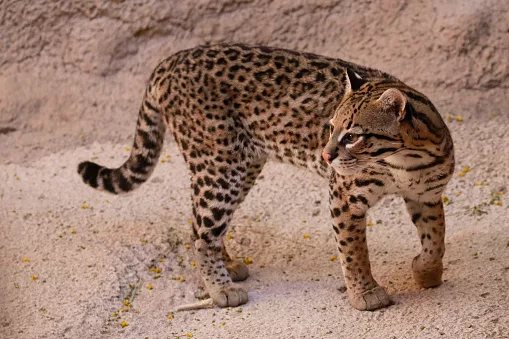
In 2016, a man near Bolivia's Yungas forest picked up what he thought was an odd-looking stray kitten. A year later it was clearly no house cat, and it ended up at the Senda Verde wildlife sanctuary. What happened next is remarkable: that rescued animal has now been formally described as Leopardus tilcayo, the first new species of wild cat identified by science in more than a century — the previous one was the pampas cat, back in 1923.
Bolivian biologist and National Geographic Explorer Paola Nogales-Ascarrunz, founder of the Bolivian Felids Research Program, was called in to see the animal and immediately clocked its unusual look: a small face, short rounded ears, long whiskers and a slender, leopard-spotted body. At roughly 1.4kg, it is one of the world's smallest and least-known felines. She assumed it was a tiger cat (Leopardus tigrinus), a species also called tigrina, oncilla or little spotted cat.
The breakthrough came in 2019, when she compared her photos with reference images of Brazilian tiger cats and spotted a clear difference: the Bolivian cat had much larger rosettes. Genetics settled it. Working with geneticist Eduardo Eizirik in Brazil and Jonas Lescroart of the University of Antwerp, the team compared genomic data from 38 individuals across the Leopardus genus and found the Bolivian cat was distinct — it likely split from its tiger cat relatives around 1.4 million years ago. The study, published in Current Biology, also brings the count of recognised tiger cat species to five and points to a new subspecies in Peru.
Why should anyone planning a trip care? Because it rewrites the wildlife map of a place you can actually visit. The Yungas — cloud forests on the eastern slopes of the Andes — are a few hours' drive from La Paz and already popular with birders and wildlife lovers. Scientists still don't know how many Tilcayo cats survive, or even what they eat and what threatens them, so don't bank on seeing one. But the discovery underlines how much hidden life these forests hold, and why protecting them from ongoing habitat loss matters.
There's a bigger story too. Small wild cats are elusive, easily confused with their close relatives, and even museum specimens have been misidentified. The genomic tools that exposed L. tilcayo could reveal further unknown species — possibly in Africa and Asia. A creature unknown to science was living in a Bolivian forest, hiding in plain sight. It's a good excuse to look closer at destinations you thought you already knew.