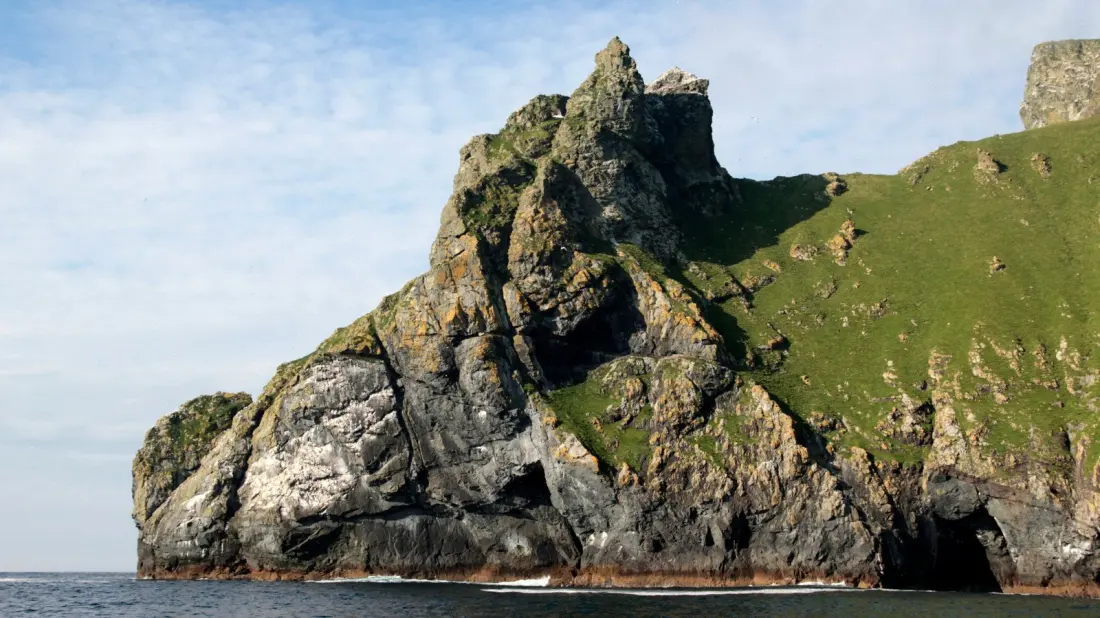
Four hours off the Scottish coast, on an island nobody has permanently lived on since 1930, a wall of rock drops more than 1,400 feet straight into the Atlantic. Conachair on Hirta, the largest island of the St Kilda archipelago, is officially recognised as Britain's highest sea cliff — and reaching its summit is one of the most rewarding hikes in the Outer Hebrides.
The geology here is dramatic by any standard. St Kilda is what remains of a volcanic complex that erupted around 60 million years ago; glaciers and relentless Atlantic waves then carved the coast into sheer headlands and jagged offshore stacks. The whole archipelago is now a UNESCO World Heritage Site, partly for its rock formations and partly for its wildlife: St Kilda hosts the largest seabird colony in the North Atlantic, so expect gannets, puffins and fulmars wheeling around you at every turn.
Most visitors treat Conachair as a long day trip. The journey starts at Leverburgh on the southern tip of the Isle of Harris, where boats make the two- to three-hour crossing to Hirta. Once ashore, a National Trust for Scotland ranger gives a briefing before you're free to explore. There's no accommodation on the island apart from a small NTS campsite, and no phone signal or internet — the views have to do the talking.
A good route begins in the abandoned village below, where 19th-century stone houses and a former church still stand, and a restored cottage now serves as a small museum about the islanders' lives. From there, the trail climbs through The Gap and Mullach Mor to the summit — about 3.5 miles of steep, pathless terrain with boggy patches and exposed edges. Note that a 2025 landslide left some slopes unstable, though the NTS confirms the summit remains reachable via Mullach Mor. On a clear day, the payoff is the scattered silhouettes of Boreray and Soay rising from the sea, with seabirds drifting below your feet.
This is a trip for fit, self-sufficient hikers rather than casual sightseers — weather windows are narrow, the crossing is long, and the terrain is serious. But if you want Britain's wildest coastline at its most spectacular, nothing on the mainland comes close. Continuing through the Outer Hebrides afterwards, the Isle of Lewis and its famous standing stones make a natural next stop.