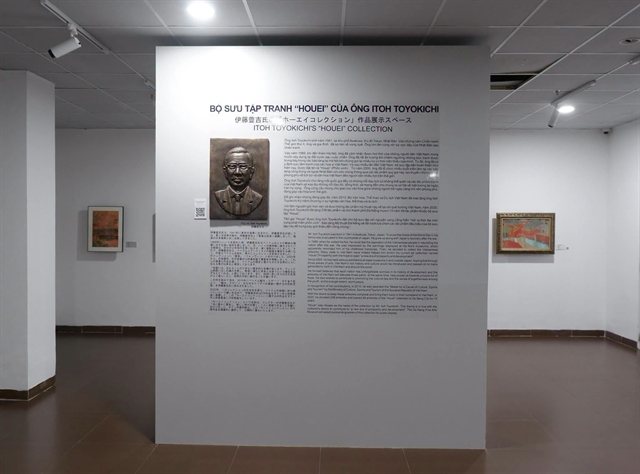
A quiet corner of the Đà Nẵng Fine Arts Museum now tells one of the warmer stories in Vietnam-Japan cultural ties. The museum, at 78 Lê Duẩn Street, has opened a permanent display space dedicated to Toyokichi Itoh, the Japanese collector who died in 2025 at 84, and to the paintings he spent nearly four decades gathering.
Itoh's connection with Vietnam began with a first trip in late 1986, when he fell for the country's art scene. From 2020 he donated 259 works by celebrated Vietnamese painters to the museum outright, and lent a further 49 pieces from his collection — named Houri, meaning Prosperity — for long-term display. That's a serious body of work, featuring names any art lover will recognise: Nguyễn Gia Trí, Trần Văn Cẩn, Tự Duyên and Dương Bích Liên, all graduates of the Indochina College of Fine Arts, the school that shaped modern Vietnamese painting.
Standouts on show include Young Woman, a silk painting by Tô Liên, and Folk Festival, a finger-print painting on silk by Tú Duyên. Silk painting is one of Vietnam's signature mediums, and seeing masterful examples outside Hanoi or Ho Chi Minh City is a treat in itself.
Before he died, Itoh was recognised by both governments: certificates of merit from the Ministry of Foreign Affairs and Đà Nẵng City, plus a commemorative medal from the Ministry of Culture, Sports and Tourism. He had shown the collection in Japan and internationally, hoping to carry Vietnam's cultural story far beyond its borders. Museum deputy director Nguyễn Thị Trinh put it plainly: the collection carries both artistic value and the affection of a Japanese friend for Vietnamese art, and the museum keeps it on view daily for local and international visitors.
For travellers, this is a good reason to put Đà Nẵng's fine arts museum on the itinerary alongside the beaches and the Marble Mountains. The city is usually marketed as a gateway to Hội An and the Hai Van Pass, but its own cultural stops reward an afternoon. Admission is modest, the building is air-conditioned relief from central Vietnam's heat, and the Itoh collection gives you a crash course in 20th-century Vietnamese painting — lacquer, silk and oil — all in one visit.
Who's it for? Art-inclined travellers, obviously, but also anyone who enjoys a story about a place. Itoh never sold the collection for profit; he gave it to the city that first drew him in. Standing in front of a Nguyễn Gia Trí with that context makes for a more memorable half-hour than most museum visits.