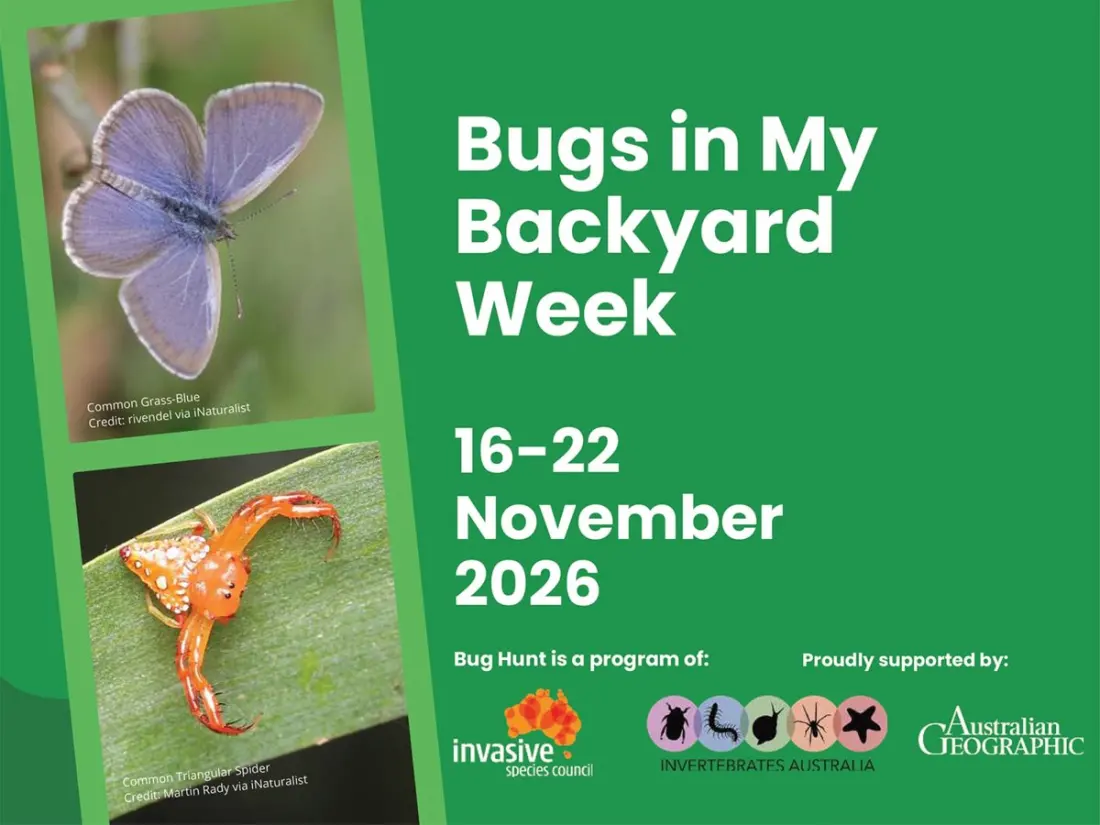
Australia's strangest and most charming citizen-science project is back. Bug Hunt, run by the Invasive Species Council with Invertebrates Australia, invites anyone with a phone to photograph bugs, spiders, snails and other invertebrates and upload them to iNaturalist — and this year's coordinated week runs 16–22 November.
The idea is simple: while you're poking around your garden, a local park, a schoolyard or a bushwalking trail, you're also helping scientists. Every record builds a clearer picture of Australia's hugely under-documented invertebrate life, and a swarm of thousands of observers at once doubles as an early-warning system for invasive species arriving in new areas. You don't need to know what you're looking at — experts and the Bug Hunt community identify your photos for you.
The 2025 edition showed the model works. More than 5,000 people logged over 40,000 observations, documenting thousands of native species and even picking up threatened ones: the fluorescent Kaputar pink slug, the Eltham copper butterfly and the iconic Bogong moth all appeared in the records. The project's success earned it the Australian Geographic Society's Gold Award for Nature in 2025, while Invertebrates Australia — which also runs a Christmas Beetle Monitoring Network — took silver.
It's not just for solo naturalists. Schools, libraries and community groups get their own program of Bug Hunt events, displays, competitions and educational resources, so kids can play bug detective too. Everything you need is at bughunt.org.au.
Why should a traveller care? If you're in Australia in mid-November, joining the hunt is a free, genuinely local way to see the country — its bushland, parks and backyards — through a naturalist's lens rather than a tour bus window. Even a couple of decent photos from a city park contribute to real science, and having experts identify what you've found is a surprisingly addictive perk. For nature-loving visitors, it's the rare travel activity where showing up with nothing but a phone makes you useful.