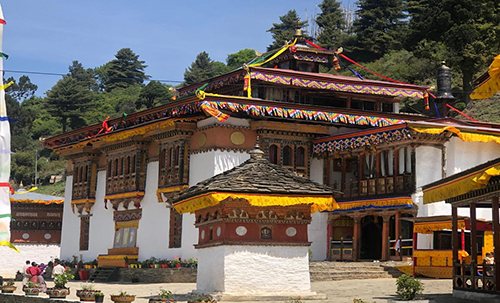
High in the Chapcha area of Chhukha district, at roughly 2,950 metres, sits Dokhachoe Gompa — also called Dargaycholing — a Kagyu monastery founded in the mid-17th century by Choje Lama Thinley Gyatsho, an early student of Zhabdrung Ngawang Namgyal, the Tibetan lama who unified Bhutan. The name means "Upright Boulder Monastery," after a towering rock on the site that was once used as a platform for blowing ceremonial horns.
The ground-floor altar holds statues modelled on the famous Jowo Rinpoche of Lhasa, including a Shakyamuni image said to contain a gem called Nob Samphyel. Pilgrims consider paying respect here equivalent to visiting the Lhasa original. Upstairs, the Kanjur Lhakhang houses a shrine to Ekajati, Bhutan's fierce protector deity, where devotees consult divination dice that display the auspicious numbers 5, 13 and 15.
The monastery's legends are its main draw. A statue of Zhabdrung Ngawang Namgyal — reportedly carved and animated by the man himself — is said to have bowed when asked to serve as his stand-in, which explains its slight downward tilt. Later, when the statue sat temporarily in another village, a mute caretaker watched it weep and speak, declaring that it belonged at Dokhachoe. Behind the main building is the Drupkhang, the meditation cave where Lama Thinley Gyatsho is said to have seen a celestial realm through the rock after three days of practice.
Ekajati is the star. Known also as Aum Ngarsum or Aum Kanchima ("one-legged goddess"), she is depicted with a single eye, tooth, leg, arm and breast — one legend says Guru Padmasambhava pierced one eye to sharpen her vision for battling demons. Locals credit her with granting three kinds of wishes quickly: worldly success (including study, legal cases and even visa applications), children, and healing from illness. Visitors can receive Serkyem, a blessed offering drink, between 10am and noon. Her statue at the gompa arrived under colourful circumstances too — carried from Tumdra Ami Ney near Phuentsholing during the 1864 Duar War, it supposedly refused to be lifted at Chapcha Zimla and pointed the way to its current home.
Other curiosities include a silver stupa that looks wooden (containing a golden statue donated by a devotee named Namgyem) and a Ganapati statue said to be one of five carved by Manjushri, one of which reportedly flew to Japan. The monks stress one correction to popular belief: while Ekajati is worshipped here, her true residence is Pasakha Tumdra Ami Ney; Dokhachoe is the sacred seat of its founder.
For travellers, this is a chance to see a living pilgrimage site most visitors to Bhutan never reach — visited by officials from Thimphu and every local born in Chapcha, yet absent from standard itineraries. Come with a guide who speaks Dzongkha, dress modestly, and time your visit for the late-morning Serkyem offering.