Road-tripping through Colombia just got a little less stressful. The Ministry of Transport has clarified that traffic officers cannot fine drivers for first-aid kits that are missing individual items or contain expired medicines. The kit itself is still mandatory — but its contents are not micro-managed by law.
The reasoning is simple: Colombia's National Traffic Code requires vehicles to carry a first-aid kit but never defines an exhaustive list of what goes inside it. The relevant offence, coded C.11, only covers a vehicle lacking the required roadside safety equipment. Officers therefore cannot demand painkillers, specific bandage types or other medical supplies that no regulation actually mandates, and medicines with lapsed expiry dates are not, on their own, grounds for a citation.
That said, the required kit is broader than just the first-aid box. Under Article 30 of Law 769 of 2002, vehicles on Colombian roads must carry a jack, a lug wrench, two reflective warning triangles (or flashing yellow lamps), a fire extinguisher, two wheel chocks, a basic tool kit, a flashlight and a spare tyre — alongside the first-aid kit. Missing any of these can trigger a C.11 fine worth 15 daily legal minimum wages, which adds up to serious money.
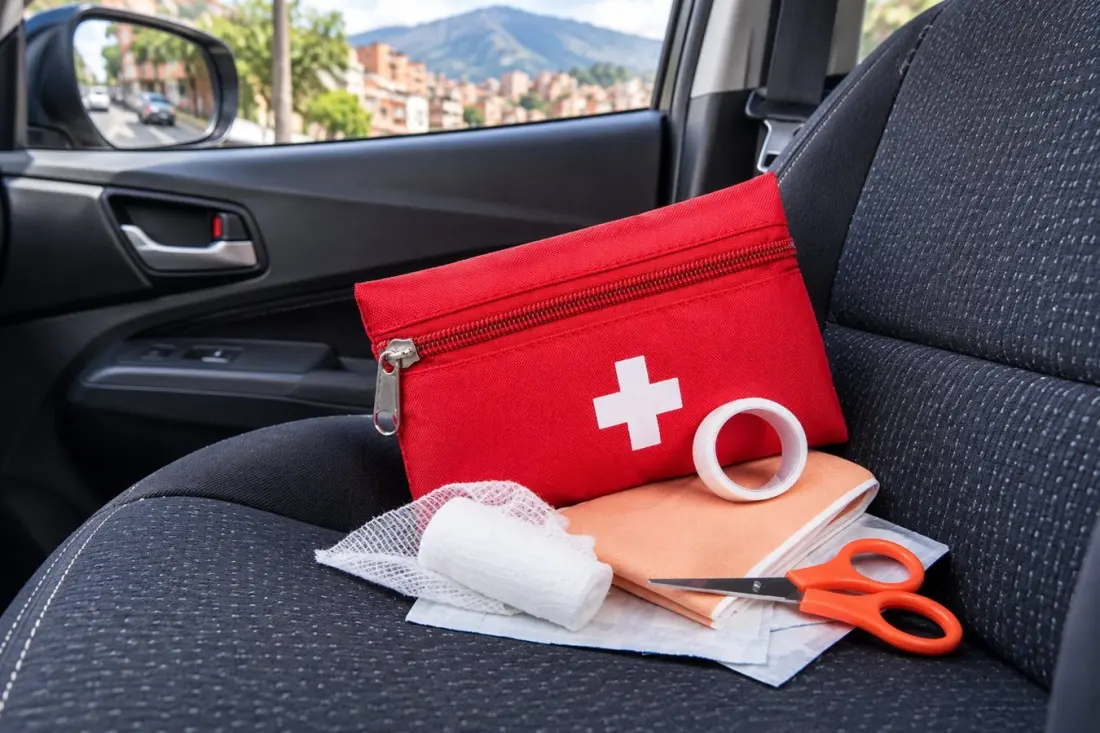
For the kit itself, Colombian pharmacies and automotive shops sell ready-made options. A practical box typically holds antiseptics such as alcohol, hydrogen peroxide, saline and povidone-iodine; sterile gauze, elastic and adhesive bandages and tape; cotton wool, tongue depressors, disposable gloves and scissors. Medicines are optional extras — worth carrying and checking regularly, but not a legal requirement.
If a driver does get cited over missing or expired kit contents, the ministry's interpretation gives grounds to challenge the fine through the standard administrative traffic procedure. The bottom line: carry the legally required safety equipment, keep the first-aid kit sensibly stocked, and know that a stale bandage or absent painkiller can't be used to write you a ticket.
Why should travellers care? Anyone renting a car or driving between Colombian cities — from Bogotá to Medellín to the Caribbean coast — will face the odd roadside inspection. Knowing exactly what must be on board (and what doesn't) helps you check a rental before setting off, avoid a costly fine, and be genuinely prepared for a roadside emergency rather than just paperwork-compliant.