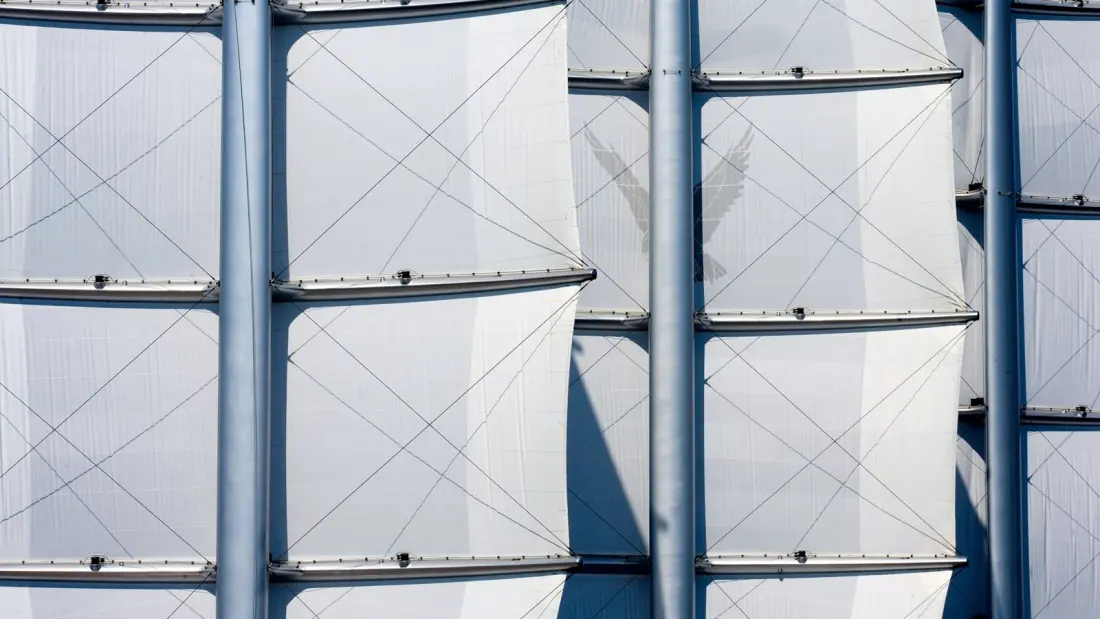
The most futuristic thing happening in yachting right now looks surprisingly old-fashioned: sails. Three huge DynaRig projects are in build, and one of them — a rumoured 120m sailing monohull with twin 82m rigs — would be the largest 'proper' sailing ship ever constructed.
If you've seen the iconic Maltese Falcon gliding through the Caribbean, you already know the DynaRig look: three freestanding, rotating carbon masts with rigid yards and square sails that furl away like window blinds. The system was dreamed up by German engineer Wilhelm Prölß in the late 1960s for cargo ships, but it needed carbon composites to become real. Visionary owner Tom Perkins backed the concept for the 88m Maltese Falcon in 2001, and designer Gerard Dykstra's team turned it into something one crewmember could operate entirely by push-button.
Only one other yacht has used the rig since — the 106.7m Black Pearl, which crossed the Atlantic using barely any fuel and once set 158 different sail configurations on a single crossing, all managed by one person. It can deploy its 3,000m2 of canvas in eight minutes. Twenty years of data from those two boats, plus a new factory in southern Poland with a 90m oven for curing enormous carbon mast sections, has given builders the confidence to scale up.
The three new commissions are strikingly different. There's the secretive 120m+ monohull, whose sail area will be double Maltese Falcon's. There's a 58m aluminium adventure catamarar under construction at Echo Yachts in Australia, set to become the world's largest sailing multihull when it launches in March 2028 — with a helideck and 12m dive tender made possible by the absence of standing rigging. And, most intriguingly, Greenpeace is building a 75m ship at Spain's Freire shipyard with two 60m DynaRigs as its primary propulsion, explicitly designed to show the commercial shipping industry what's possible.
That last point matters beyond superyachts. With emissions targets tightening from 2030, cargo shipping faces real pressure to cut fuel burn, and wind-assisted propulsion is one of the few proven answers. The DynaRig's appeal is practical: no loaded sheets, no complicated rigging, sails furl in sequence rather than reefing, and plain Dacron cloth works fine — no exotic laminates required. Maltese Falcon's masts have never been removed in over two decades of sailing.
For travellers, the takeaway is that wind-powered voyaging is edging back into the mainstream. If you want to experience it now, Black Pearl is on the charter market at $850,000 a week. For everyone else, expect sail-assisted expedition cruises and low-emission crossings to become a genuine option over the next decade — the technology finally seems to have caught up with the idea.