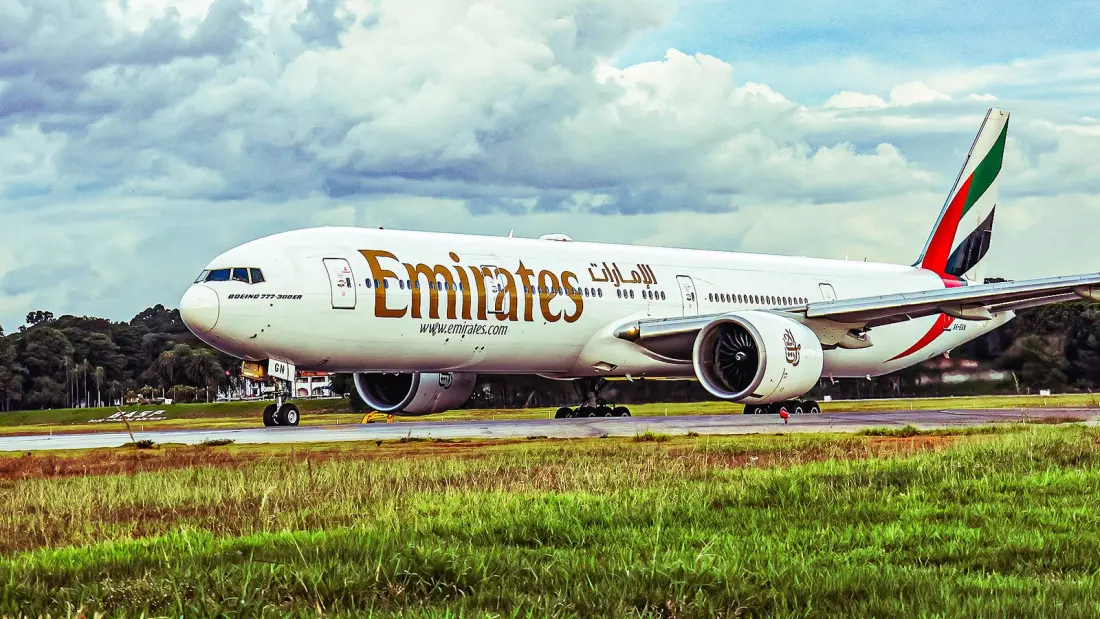
No airline flies more Boeing 777s than Emirates. The Dubai carrier currently operates 145 of the twin-jets across passenger and freighter variants, comfortably ahead of the 116 Airbus A380s that make up the rest of its widebody fleet. And with a staggering 270 777X planes on order, that lead will only widen over the next decade.
The current fleet breaks down into 117 777-300ERs (average age 13.3 years), 18 777-200LRs and 18 777F freighters averaging under four years old. Emirates has already retired its original 777-300s, which arrived from 1997 after the airline's first 777 order was placed back in 1992 — a deal of seven jets plus seven options, described at the time as a vote of confidence in an industry reeling from the first Gulf War.
For travellers, the 777-300ER is the workhorse you're most likely to board out of Dubai. Last year its busiest routes were to South Asia: four daily rotations to New Delhi, three to four daily flights to Male in the Maldives (1,444 flights across 2025), and daily service to Chennai and Hyderabad. Manila matched those Indian cities at 1,095 flights, while Johannesburg and Cape Town each saw roughly two daily frequencies. Regional Gulf routes matter too — Riyadh got 1,177 flights, with Kuwait City and Dammam close behind.
The future belongs to the 777X. Emirates committed to 150 of them in 2013, added 90 more at the 2023 Dubai Airshow, and now has 270 on firm order — split between the larger 777-9 and the 777-8 — destined to eventually replace the A380. First deliveries are expected in the second quarter of 2027, and Boeing won't clear the backlog until at least 2038. Frustrated by years of delays, Emirates has even refused to accept around ten pre-built 777Xs that have been sitting storage-bound since being completed years ago, with president Tim Clark describing them as looking "very sad" outside the Renton factory. One airframe that had already been partially painted in Emirates colours was scrapped outright in July. There's talk the airline could convert its 35-strong 787 order into even more 777Xs.
Why does this matter if you're not an aviation geek? Because the 777-300ER carries the bulk of Emirates' point-to-point flying from Dubai to South Asia, Southeast Asia, Africa and the Gulf — the routes where you'll often find lower fares and less competition than on A380 trunk routes. Knowing which aircraft flies your route helps you pick seats, predict cabin layouts (Emirates' 777s come in several configurations, including the newer Premium Economy) and decide whether to hold out for the radically updated 777X cabins when deliveries start in 2027. Frequent flyers to Delhi, Male, Manila or Johannesburg are effectively flying on the backbone of the world's largest 777 operation right now.
Story first reported by Simple Flying.