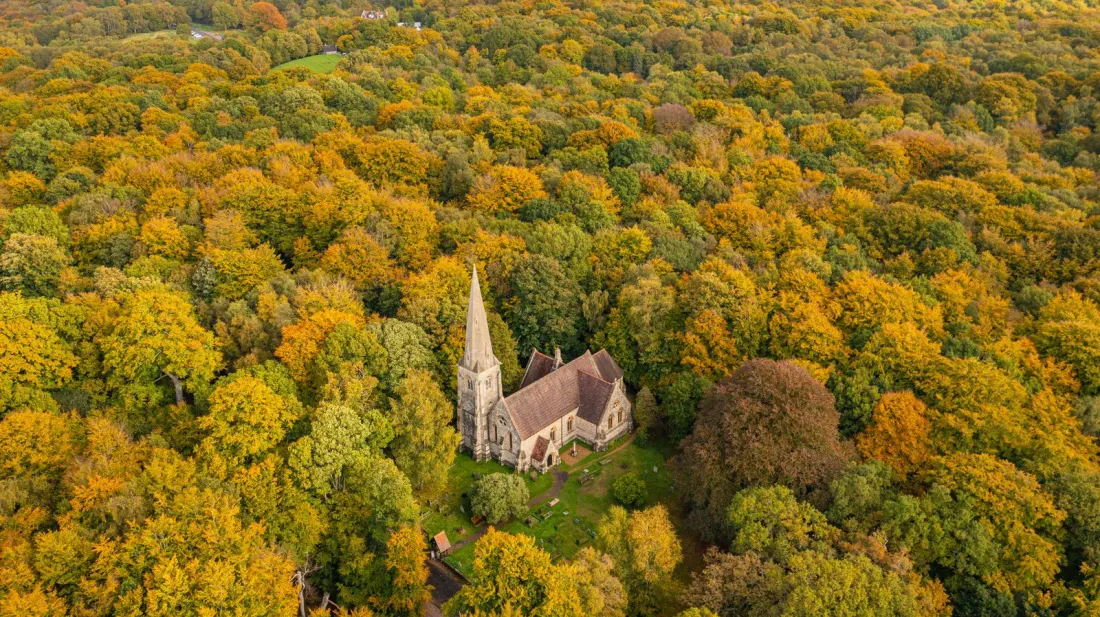
Less than an hour from central London, nearly 6,000 acres of ancient woodland stretch across the border between East London and Essex. Epping Forest, once a royal hunting ground complete with a lodge built for Henry VIII and later renovated for Elizabeth I, is now a protected landscape of hornbeam, beech and silver birch, laced with ponds, lakes and walking trails. Much of the surrounding district sits within London's Green Belt, so the area has held onto its rural feel — 94% of it, by local tourism figures — despite being firmly on the Tube map.
Walkers have plenty of options. The 3.25-mile Chestnut Trail runs between Leyton and Ilford through woods, grassland and pond-side paths, with a detour to the overgrown 18th-century Grotto, an ornamental boathouse and garden. The shorter Golden Hill Trail, 1.6 miles north of Loughton, passes some of the forest's oldest trees, and the Epping Forest Heritage Trust lists guided walks covering everything from fungi to autumn colour.
Water lovers get their share too. Strawberry Hill Pond, ringed by conifers and sweet chestnuts, is a picnic spot where ducks drift on still water. Connaught Water, in the forest's southern section, has a car park and a path around its edge, plus a fishing platform during the season — and a resident cast of geese, swans, herons and crested grebes. Cyclists can tackle a 15-mile mountain bike loop marked on Komoot, manageable for most skill levels with around 800 feet of climbing.
Families have easy add-ons nearby: Redwings Horse Sanctuary at Ada Cole with its rescued horses, ponies and donkeys, introductory lessons at High Beech Riding School, and Lee Valley Animal Adventure Park in Waltham Abbey.
The towns inside the district are worth time in their own right. Epping, the Central Line's eastern terminus, keeps a medieval market tradition alive with a Monday market of more than 30 stalls, alongside pubs, bistros and independent shops. Loughton has a lively high street and a genuine curiosity: the National Jazz Archive, a free collection of jazz journals, photographs and posters dating back to the 1920s, currently visitable by appointment. Waltham Abbey is dominated by its church, where King Harold II — the last Anglo-Saxon king, killed at Hastings in 1066 — is believed to be buried. Local lore even credits a hall in town with the first performance of Shakespeare's A Midsummer Night's Dream.
For London-based travellers, this is a straightforward day trip: Epping and Loughton sit directly on the Central Line, while the nearest station to Waltham Abbey is Waltham Cross, about a mile and a half away. Summer is generally considered the best time to visit the UK, but the forest earns its keep year-round — spring birdsong, shaded summer walks, and autumn colour among the old trees all have their fans. Pack decent shoes, check the Heritage Trust's walk listings if you want company, and give yourself half a day at minimum to see why poets once fancied this woodland stood where London should have been.