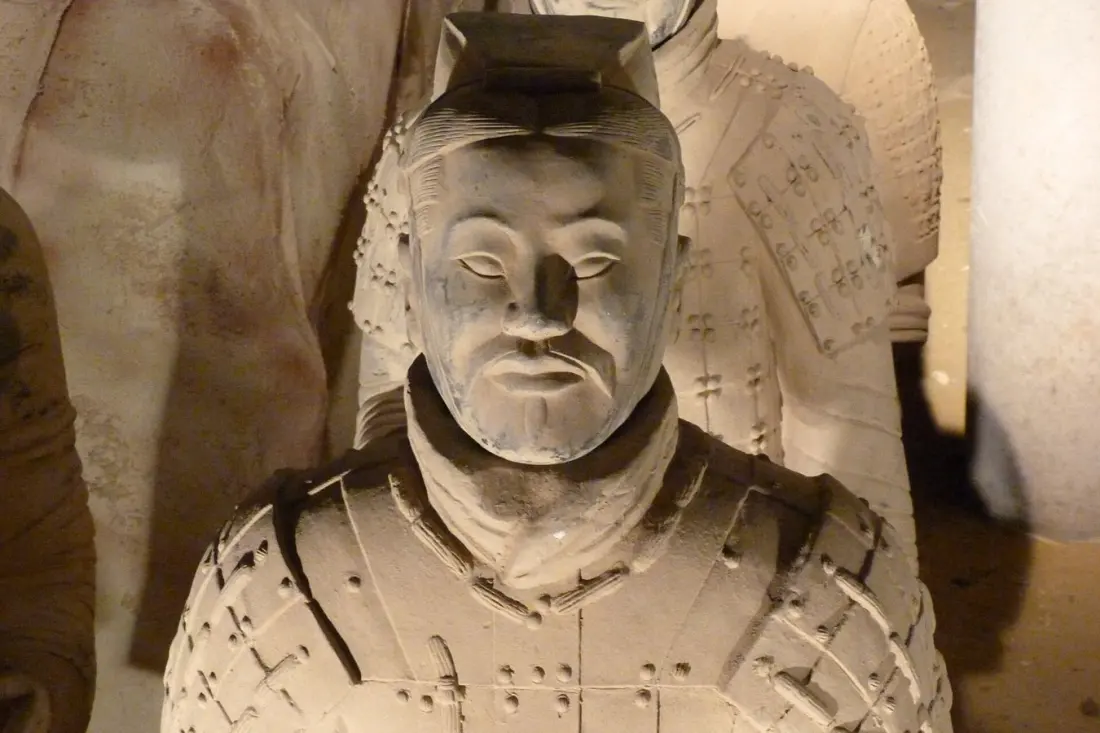
A fresh analysis of fingerprints left in the clay of China's Terracotta Army suggests the famous warriors weren't made by adult men alone. According to a study published in the Journal of Cultural Heritage, women and children under 15 likely helped shape the life-sized soldiers buried near Xi'an more than 2,200 years ago.
Researchers examined 79 well-preserved prints from 36 warriors in one section of Pit 1 at Emperor Qin Shi Huang's mausoleum. By measuring the width of the ridge lines — which hint at age and sex — and running the data through a Bayesian statistical model, they estimated that roughly 45% of the prints came from adult men, about a third from adult women, and around 22% from children under 15.
The team is careful with the numbers. Ridge widths overlap between groups, clay shrinks during firing, adult women and teenage boys are hard to tell apart, and the reference dataset came from modern Europeans rather than ancient Chinese populations. So the figures are statistical estimates for one excavation area, not a census of the whole workforce. Still, the findings back up historical records showing that women and children took part in craft production during the Qin dynasty, possibly as apprentices in organised workshops.
The Terracotta Army itself remains one of archaeology's great finds. It was built for Qin Shi Huang, the first emperor to unify China in 221 B.C., to accompany him in the afterlife. Thousands of soldiers, horses and chariots stand in military formations underground, each assembled from separately made parts, so no two faces are quite the same. The world only learned of it in 1974, when farmers digging a well near Xi'an in Shaanxi province struck fragments of the figures.
For travellers, the story adds a human layer to a site many already have on their list. When you stand in the hangar-like pits outside Xi'an, you're not just looking at an imperial vanity project — you're looking at the traces of ordinary hands, including possibly teenage apprentices, pressed into the clay two millennia ago. It's a good reason to linger at the exhibits explaining how the warriors were assembled, and to book a guided tour that covers the workshop system behind the army.
Who's it for? Anyone planning a China itinerary around history: Xi'an pairs naturally with Beijing and the Great Wall, and the mausoleum site is an easy half-day trip from the city. Even frequent visitors to China who haven't made it to Shaanxi often rank the warriors as the country's single most impressive sight.