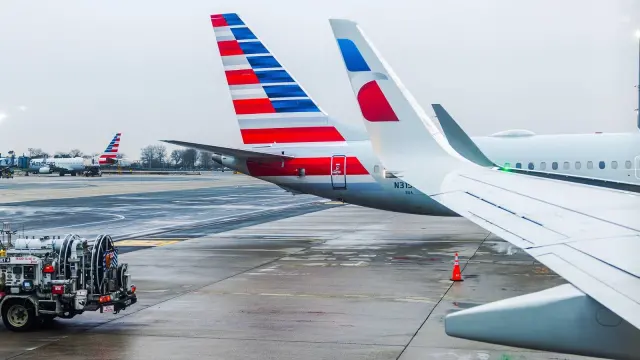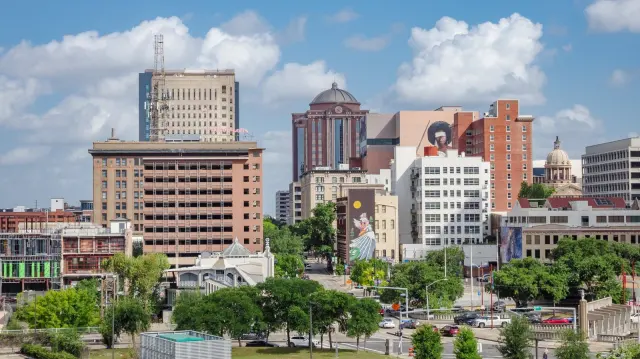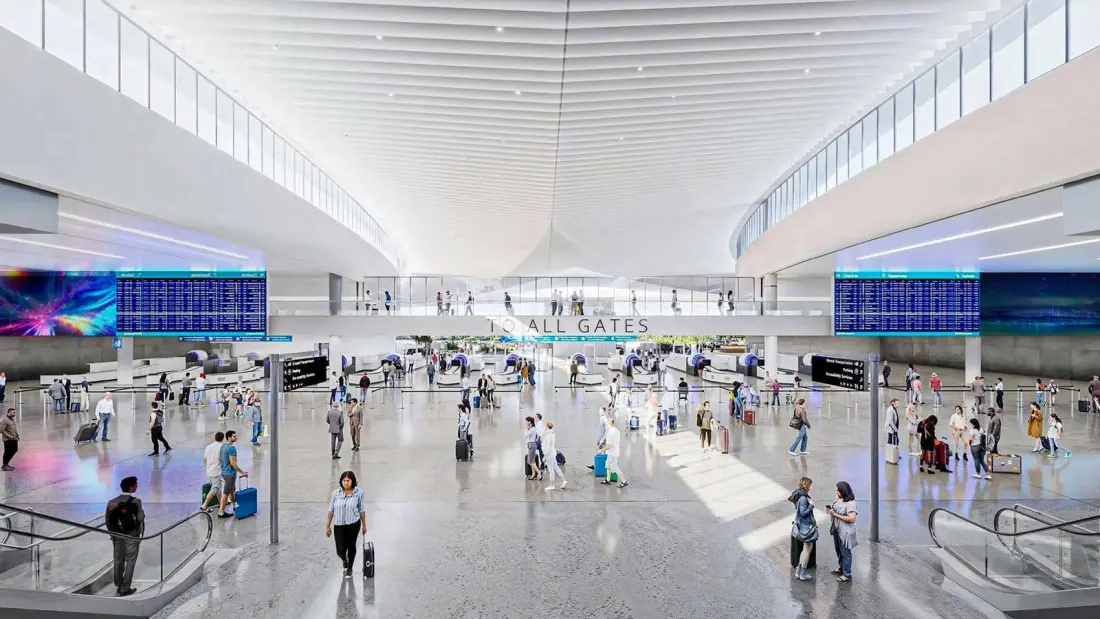
While billion-dollar megahubs grab the airport construction spotlight, the most passenger-visible upgrades right now are happening at mid-sized US airports that outgrew their terminals. A common pattern: gate shortages plus terminals split into wings, each with its own security checkpoint. Five projects hit visible milestones in 2026, with most finishing between 2028 and 2029.
Omaha's Eppley Airfield is furthest along. Its $950 million Build OMA program roughly doubles the terminal, from 375,000 to 646,000 square feet, and four new gates (A1, A1A, A1B, A2) opened on November 4, 2026, already in use by Delta. The expansion adds two international gates with a customs hall, and the endgame is a unified concourse fed by one centralized TSA checkpoint inside a new central pavilion with a food court and shops. That pavilion opens in early 2027, with the full program on time and budget for 2028.
Spokane International is mid-way through its TREX program. Concourse C wrapped up on May 26, 2026, adding six gates and ticket counters across its two phases. Next comes a Central Hall that merges the airport's two separate checkpoints into one, connecting all three concourses. The scope has ballooned from a planned 145,000 square feet at $152 million to about 255,000 square feet at an estimated $335 million, driven by growth forecasts of 6.2 million annual passengers by 2030.
Columbus is going biggest: a roughly $2 billion replacement terminal at John Glenn International (CMH), the priciest public works project in Franklin County history. Gensler designed a 36-gate, 1-million-square-foot building with a single security checkpoint replacing today's three, plus two international gates with customs. Steel went vertical in 2026, and the airport now targets January 2029, deliberately timed to the airport's 100th anniversary. The 1958 terminal will be demolished and its site converted to overnight aircraft parking.
Richmond International, newly upgraded to medium-hub status after 2.48 million enplanements in 2025, is tackling its split-checkpoint problem head-on with a $253 million Consolidated Security Screening Checkpoint: about 10 lanes opening, expandable to 14, plus a reworked atrium and new post-security concessions. October 2026 brought approved design contracts led by Gresham Smith and a $5.8 million FAA grant, though no firm opening date yet.
Boise rounds out the list with a different priority: gates, not checkpoints. Traffic there jumped 81% in a decade, prompting a shift to medium-hub status and a $700 million Concourse A and Terminal Improvements contract with Hensel Phelps, adding up to 10 gates through 2029 alongside baggage handling and terminal flow upgrades. Notably, no local taxes are involved - it's funded by airport revenue and passenger facility charges.
For travellers, these projects matter in the near term mainly as a heads-up: expect shifting checkpoints and construction hoardings at Omaha, Spokane, Columbus, Richmond and Boise through the decade's end. But by 2028-2030, each promises shorter security lines, more gates and airlines, and less guesswork about which entrance to use - exactly the kind of low-stress airport experience that makes regional flying far more pleasant.