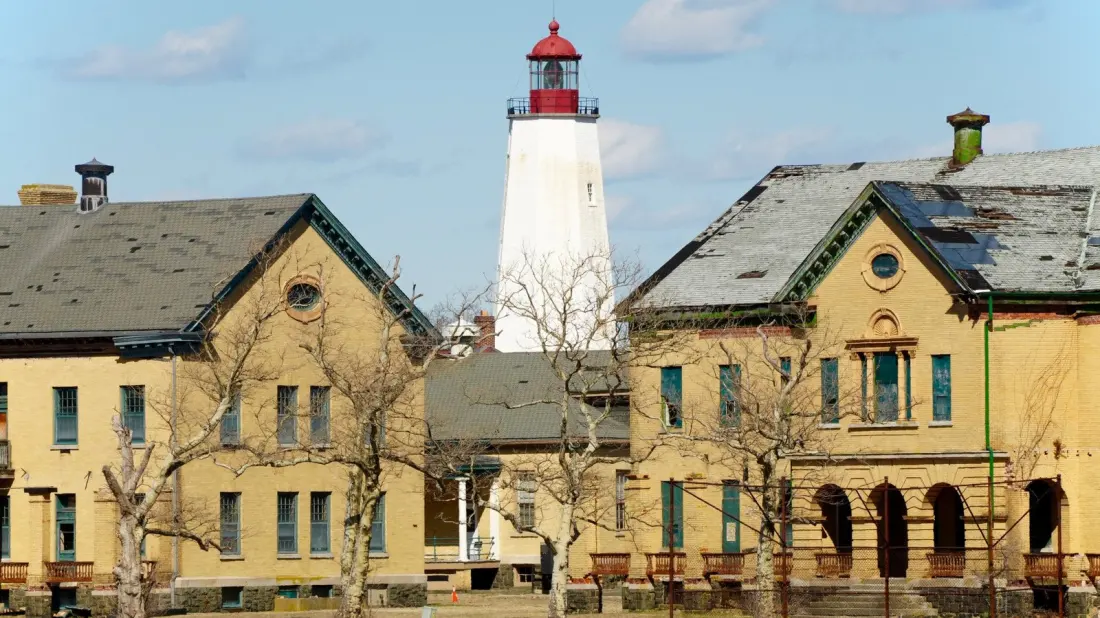
An hour and a half from New York City, the Sandy Hook peninsula in Monmouth County packs military history and beach day into one thin strip of sand. It's part of Gateway National Recreation Area, and its centrepiece is Fort Hancock, a former U.S. Army post that guarded New York Harbor for the better part of two centuries before opening to the public in 1974.
The history runs deep. A lighthouse has stood here since 1764, making it the oldest continually operating lighthouse in the United States. The British occupied the peninsula during the American Revolution, and the government took it over for military use in 1806. From 1874, the Sandy Hook Proving Ground tested new weapons before they entered service, and Fort Hancock, renamed in 1895, stayed active through World War II, when over 7,000 soldiers, including Women's Army Corps members and African American troops before desegregation, supported the harbor's coastal defense. Cold War anti-aircraft guns eventually gave way to missiles before the fort was deactivated.
Today you can tour much of it for free. Ranger-led walks cover the Fort Hancock Museum, the Potter and Granger gun batteries, and the lighthouse itself. Prefer to wander solo? A self-guided brochure from the Sandy Hook Visitor Center maps out 39 stops, including Officer's Row, the Post Theater, and a World War II Victory Garden. The lighthouse climb is the big draw: free tours run Friday through Monday, 1 p.m. to 3:30 p.m., but groups are capped at eight people, so arrive early in summer or you'll miss out. Grounds are open year-round, 6 a.m. to 9 p.m.
Fort Hancock aside, Sandy Hook works as a proper beach escape. The six-mile barrier peninsula pulls in over two million summer visitors, with skyline views across the water, swimming beaches, and several stretches where dogs are welcome. Rent a kayak or paddleboard from Sandy Hook Kayaks from $25 an hour, ride the seven-mile multi-use path that runs the length of the peninsula, or take one of three hiking trails through coastal forest and past old military installations, including the missile launch site.
Getting there is part of the appeal. In summer, a ferry runs from the Battery Maritime Building in Manhattan's Financial District and takes about an hour, a scenic option worth considering. Driving is faster and more flexible, but summer parking costs $20.
Why it matters: Sandy Hook is one of the rare spots where you can climb a colonial-era lighthouse in the morning, walk a WWII battery after lunch, and still be back on the beach by mid-afternoon, all under the National Park Service umbrella and within sight of Manhattan. It suits history buffs, cyclists, dog owners, and anyone escaping the tristate summer heat without a long drive down the Shore.