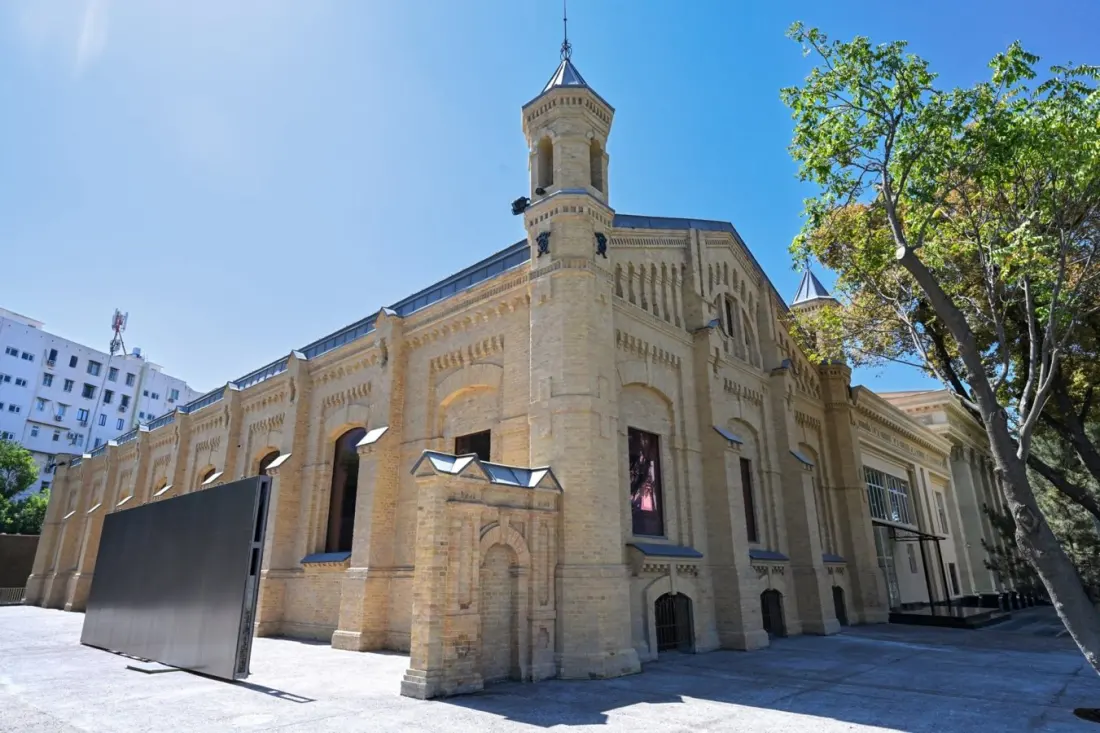
A 1912 tram depot in central Tashkent has quietly become one of Central Asia's most interesting new cultural addresses. On 6 September, the Centre for Contemporary Arts Tashkent (CCA) opened its doors — the country's first permanent space devoted entirely to contemporary art — inside an industrial complex that once powered the city's original tramway and later fed its electricity grid.
Paris-based Studio KO, the firm behind Karl Fournier and Olivier Marty's heritage-sensitive projects worldwide, handled the renovation. Their brief was to keep the building's soul intact, and they largely have: the early 20th-century brickwork has been restored, the old diesel power station now houses the main exhibitions, and the former administration block has become a bookshop and research library. The courtyard doubles as an open-air venue for film screenings and workshops.
The detailing is where it gets distinctly Uzbek. The architects mixed a bespoke concrete using local materials and commissioned handcrafted tiles from the Rakhimov family ceramics studio, filtering light through patterns drawn from regional craft traditions. There's also a concept store, a restaurant and education spaces, so you can easily lose half a day here.
The opening exhibition, Hikmah ("wisdom"), is curated by Dr Sara Raza and runs until 31 January 2027. It pairs Uzbek artists with international names — including Tunisian-Ukrainian artist Nadia Kaabi-Linke's Flying Carpets (2011), loaned from the Guggenheim in New York. Local ceramicist Shokhrukh Rakhimov contributes a site-specific installation of seven ceramic forms made with minerals and pigments sourced in Uzbekistan.
The project sits within a wider push by Uzbekistan to present its contemporary culture alongside the Silk Road heritage most visitors already come for. The Uzbekistan Art and Culture Development Foundation took over the site in 2019, and President Shavkat Mirziyoyev toured the centre before opening day. The Guggenheim's director Mariet Westermann, who attended, made the point neatly: any serious art city needs both historic treasures and the art of now.
For travellers, this is a genuine reason to look beyond Samarkand and Bukhara. Tashkent has long been treated as a transit point on Uzbekistan itineraries — a place to overnight between ancient cities. With the CCA joining a year-round programme of exhibitions, residencies, film and performance, the capital now offers something those older cities can't: a window into how Uzbek artists are working today. Come for the mosaics of the metro and the Chorsu Bazaar, stay for the contemporary art.
Story reported by Travel Tomorrow.