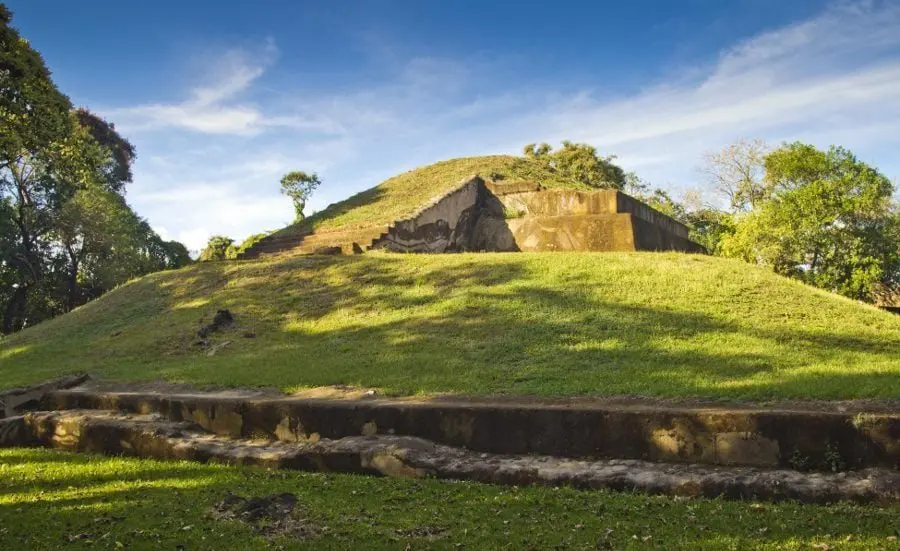
At the eastern edge of Chalchuapa in El Salvador's Santa Ana department, a small archaeological park hides one of the country's most striking visual details: a pale band of white ash from the Ilopango volcano eruption, still visible in an exposed excavation wall. Ilopango sits well to the east, so standing in front of that layer at Casa Blanca gives you a real sense of how far the eruption's fallout travelled across what is now El Salvador.
Casa Blanca covers roughly six hectares — only a fragment of the much larger ancient settlement that once spread across modern Chalchuapa, most of which has been swallowed by development. Along with the neighbouring El Trapiche sector, it formed an important early Maya centre in the late Late Preclassic period. Pollen evidence from beneath a nearby lagoon even shows people were clearing forest and growing maize before the ceremonial centre was built. When the Classic period began, the main ceremonial activity shifted to Tazumal, a short distance away, though burials found at Casa Blanca show people kept returning there well into the Postclassic era.
The park itself holds six pre-Hispanic structures, three of them pyramids. Structures 1 and 5 have been partially restored, which makes their outlines easy to pick out. At the base of Structure 5's stairway, archaeologists uncovered a basalt monument and a Late Preclassic sculpture — easy to miss unless you know to look. Step back along the path and you can read the pyramid's full slope and footprint better than from up close.
The covered site museum, built with adobe walls and hacienda-style corridors, displays a carved stone fragment from El Trapiche bearing traces of Maya writing — researchers believe much of the inscription was deliberately erased in pre-Hispanic times. Ceramics include Usulután Izalco pottery, recognisable by parallel lines on a light orange ground.
Casa Blanca also has an unusual draw for a small ruin: an añil (indigo) workshop, supported by Japan, where artisans work with dye made from the jiquilite plant. If a demonstration is running, you can watch cloth folded or tied before dipping so that undyed sections create patterns — a genuinely hands-on cultural experience.
A practical day out: pair Casa Blanca with Tazumal to follow the story of Chalchuapa's shifting ceremonial centre, with lunch in town between the two. Allow about an hour for Casa Blanca's trail and museum, more if you want the indigo demonstration. Bring water and comfortable shoes, do the outdoor trail first during the rainy season mornings, and check the Ministry of Culture's site for hours and admission — especially around holidays or if you need step-free access.
For anyone travelling El Salvador beyond the beaches, this is an easy half-day from Santa Ana that packs in early Maya history, a visible natural disaster in the earth's layers, and living craft traditions in one stop.