If a strong-to-very-strong El Niño has an 83-percent-plus chance of dominating the winter, as NOAA's Climate Prediction Center projects, the smart powder chaser books the southern Rockies and Sierra Nevada now. That's the argument from a veteran television meteorologist and skier who has mapped out which North American mountain towns stand to get buried this season — and her reasoning goes beyond the usual El Niño playbook.
Her forecast leans on a rare cocktail of climate signals: a Super El Niño driving an active southern storm track, a cooling Pacific Decadal Oscillation (a pairing last seen in the 1972-73 winter), and an unpredictable polar vortex. The early evidence is already convincing — Chile's Ski Portillo nearly doubled its average this year with close to 500 inches, suggesting what a turbocharged southern jet stream can deliver.
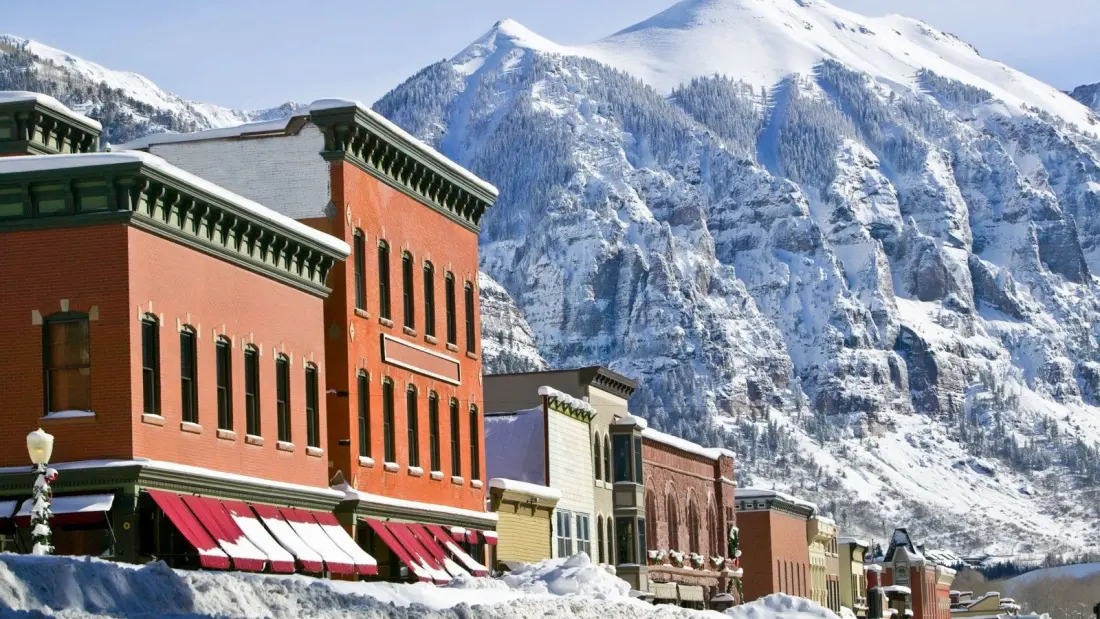
Her headline pick is Telluride, Colorado, where the San Juan Mountains sit directly in the path of atmospheric rivers. She rates it her number-one winter destination, drawn to the Victorian-era mining town below and the ski terrain of Mountain Village above, linked by a free gondola. Off the slopes there's world-class ice climbing, heli-skiing with Telluride Helitrax, and snowmobile trips to the Alta Ghost Town. Après options run from the 1895-era Historic Bar at the New Sheridan Hotel to Alpino Vino, the highest fine-dining restaurant in North America.
For sheer snow volume, though, nothing beats Wolf Creek, Colorado. The resort's base sits at 10,300 feet in an L-shaped basin that funnels storms off Wolf Creek Pass, and it holds Colorado's single-season record: 807 inches during the El Niño winter of 1978-79. Pair it with a ski-and-soak trip to Pagosa Springs on the state's Historic Hot Springs Loop.
Two wilder picks round out the list. Brian Head, Utah — the highest incorporated town in America at 9,800 feet — got heavy October snow and doubles as a base for Bryce Canyon and Zion. And in Arizona, Fort Valley near Flagstaff serves the state's only ski resort, Arizona Snowbowl, which logged 281 inches during the last El Niño winter. From there, the Grand Canyon's uncrowded South Rim is barely an hour away.
The biggest lock may be Mammoth Mountain in California. Historical precedent is striking: the 1982-83 Super El Niño delivered 546 inches there and pushed the ski season into late July. When the lifts stop, there's tubing at Woolly's Adventure Summit and the surreal sight of ice fog drifting over Mono Lake's tufa towers, where bald eagles winter.
The takeaway for skiers planning this season: favour the southern tier. Mammoth, the San Juans, Wolf Creek and even Arizona stand to benefit from the enhanced subtropical jet, while northern resorts may see a more ordinary winter. If your window is January through March — the period NOAA expects the El Niño to peak — booking a southern Rockies or Sierra trip looks like the savviest move.