
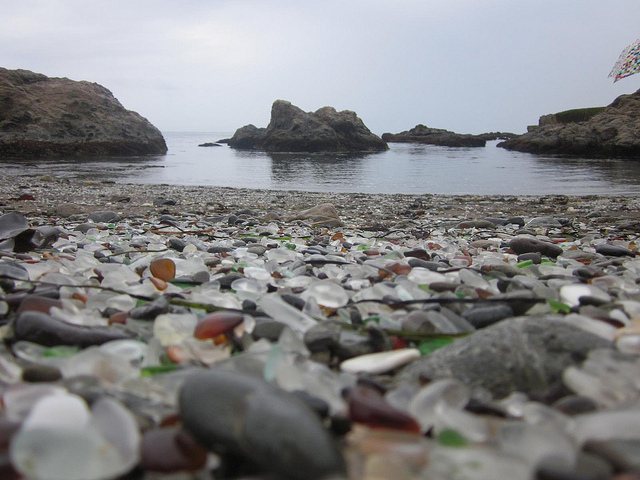
At the northern edge of Fort Bragg on California's Mendocino coast lies a beach made of smoothed sea glass in every colour you can imagine. A century ago, locals called it The Dumps.
The story starts in the late 1800s. Fort Bragg had no refuse collection, and the ocean was right there, so residents simply rolled their garbage off the cliffs above the beach. Glass, household appliances, even entire cars went over the edge, year after year, as the town grew. It took until the 1960s for city leaders and the water board to finally shut the site down as an illegal dump.
Then the ocean did the clean-up work nobody else could. Decades of waves and weather had ground the discarded glass into millions of small, rounded, jewel-like pebbles, soft-edged and polished. The name changed to Glass Beach, and in the early 2000s the California State Park system bought the beach and roughly twenty acres around it, folded it into nearby MacKerricher State Park after a final clear-out, and protected it.
Fort Bragg isn't alone. Benicia, also in California, has its own glass beach, as does Hanapepe Bay in Hawaii, and there's even one at Guantanamo Bay. Each one is the same odd recipe: human dumping plus decades of wave action.
One detail worth knowing before you go: collecting is banned. Where it was once illegal to dump glass on the beach, it is now illegal to take it away, because too many visitors pocketed souvenirs and the beach was visibly thinning. Take photos, leave the pebbles where the waves put them.
That's the hook of the place for anyone planning a Pacific coast road trip: it's a natural site that shouldn't exist, a seaside park that doubles as a century-old cautionary tale. You get a walk along a striking, shimmering shoreline, a bit of industrial history, and an easy stop between Mendocino village and the redwoods further north. The surrounding MacKerricher State Park adds dunes, tide pools and seal-watching to the day, so it works as more than a quick photo stop. Kids tend to love it — hunting for colourful glass is basically a treasure hunt — and photographers get the best of it on overcast mornings when the colours really pop.