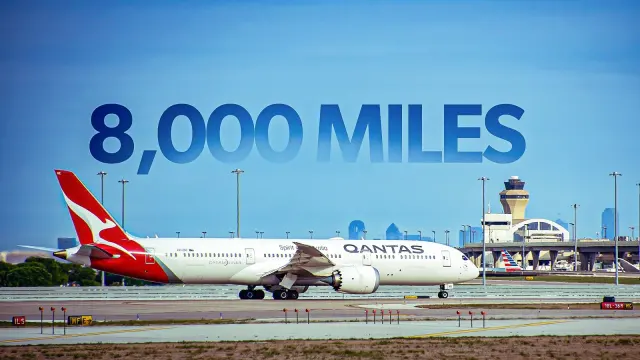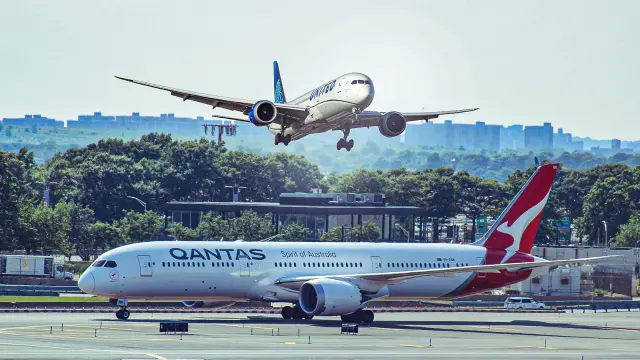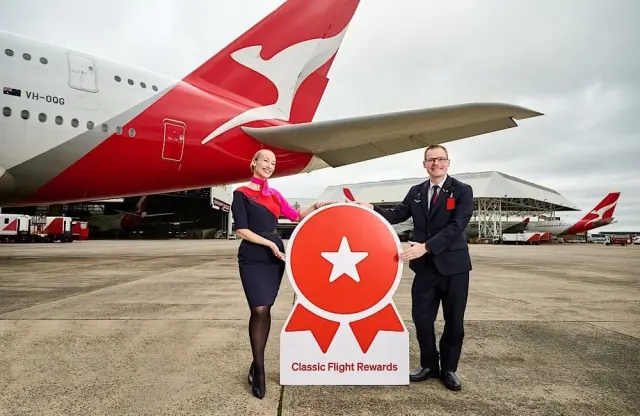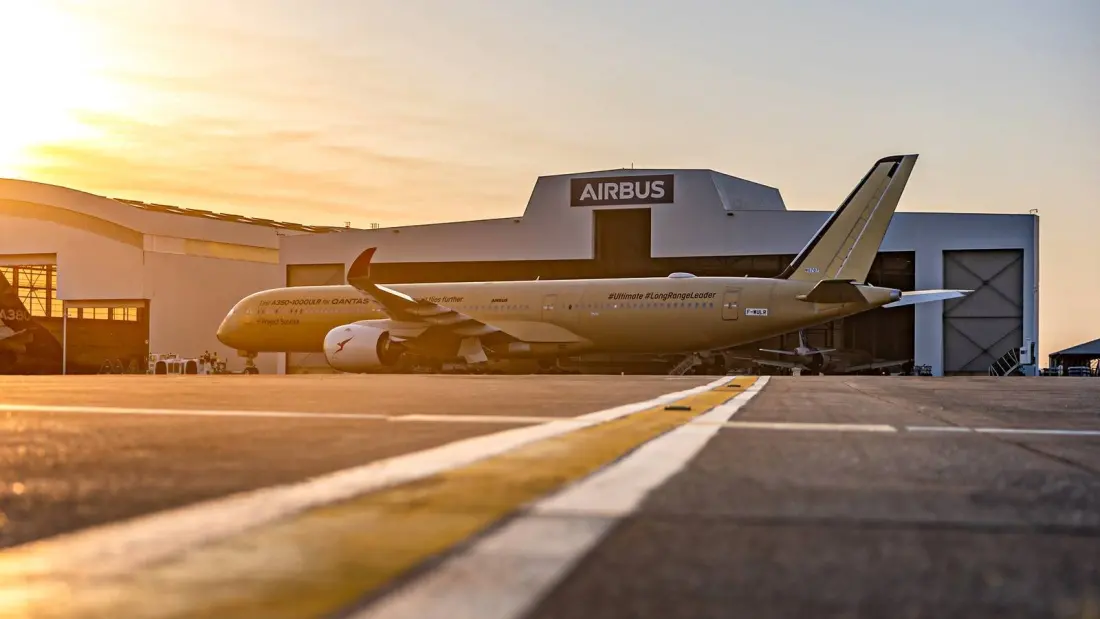
Twelve aircraft, more than 1,560 crew. That is the arithmetic behind Project Sunrise, Qantas's plan to fly nonstop from Sydney to London and New York on the Airbus A350-1000ULR — and the crew-to-plane ratio shows just how different a 22-hour flight is from anything else in commercial aviation.
Per aircraft, Qantas will train 30 pilots and 100 cabin crew, roughly double what a conventional long-haul jet needs. The reason is the mission profile: each A350-1000ULR carries an extra 20,000-litre rear fuel tank, allowing flights of more than 16,000 km and up to 22 hours. Sectors that long need extra pilots on board and extended recovery time afterwards, so each new route adds its own rostering coverage rather than borrowing spare capacity from existing ones. Qantas is also working with Australia's Civil Aviation Safety Authority on fatigue-management rules, because standard duty limits were never written for flights beyond 20 hours.
Training is already underway on Australia's first A350 simulator in Sydney, backed by a second track with British Airways in the UK, which already flies the A350-1000. The first intake comes from Qantas's own A330 pilots, with 40 currently converting while continuing their existing flying. The first aircraft is due in April 2027, leaving about six months before Sydney-London launches in October 2027 — likely with short familiarization hops to New Zealand first. Sydney to New York follows from mid-2028.
The program has taken its time. Announced in 2019, confirmed as a 12-aircraft order in 2022, and delayed several times — including a fuel-tank redesign that pushed first delivery to April 2027. The aircraft itself has since proven the concept: its maiden flight came in June 2026, followed by two nonstop Toulouse-Melbourne test flights that reportedly set a distance record for a commercial airliner.
For passengers, the cabin is where the investment shows. There are 238 seats across four classes — 6 first, 52 business, 40 premium economy and 140 economy — plus a world-first Wellbeing Zone, along with adjusted lighting and meal service designed around managing ultra-long-haul travel. CEO Vanessa Hudson has framed it as a fundamentally different way to fly, and if you've ever endured a 24-hour trip via a Middle Eastern hub, the appeal of doing it in one hop is obvious. The name honours the wartime Double Sunrise endurance flights, when Qantas first crossed vast ocean distances without landing.
Why it matters for travellers: from October 2027 you'll be able to fly Australia's east coast to London nonstop — a world first — joining the existing Perth-London service and Sydney-via-Singapore options. For anyone dreading connections, that alone reshapes how Australia fits into a Europe trip. And with Qantas hinting at more Sunrise destinations beyond London and New York, this crew-training scale-up is the clearest sign the airline intends ultra-long-haul to become a core product, not a one-off stunt. Story first reported by Simple Flying.