In Hà Nội, students flock to the Văn Miếu – Quốc Tử Giám (Temple of Literature – Imperial Academy) before big exams — a ritual that matters even more this year as the site marks the 950th anniversary of the Quốc Tử Giám, Việt Nam's first institute of higher learning. But the tradition has quietly gone global. In Toronto, the Canada-Vietnam Cultural & Educational Council (CVCEC) is proving that a love of learning can cross an ocean intact.
Council chair Phan Thị Quỳnh Trang has a personal stake in the story. Her maternal family counts imperial-exam laureates whose names are carved into the temple's stone stelae, and every trip back to Hà Nội doubles as a family check-in with that legacy. She later worked with Educap teaching Vietnamese to foreigners and guided visitors around the temple itself — an experience that shaped how she now teaches culture to kids raised in Canada.
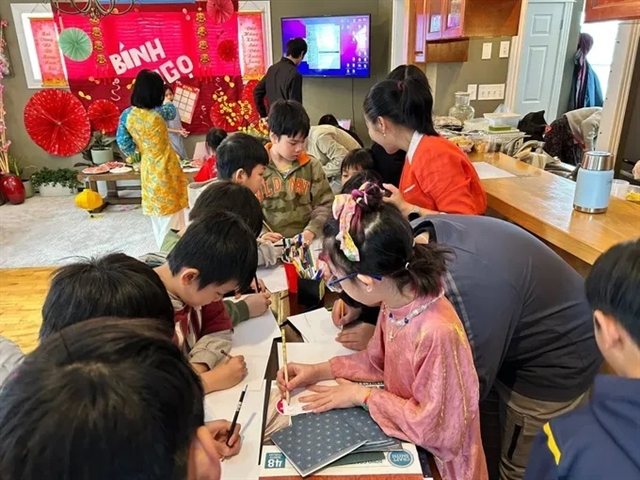
Her method is simple: make the homeland feel close rather than distant. Vietnamese-speaking households, family history told at the dinner table, and community classes all play a part. Her own son, fluent in English, still speaks Vietnamese at home and reads Vietnamese history for fun — her proof that integration and roots don't have to compete.
CVCEC's most concrete tool is Trường Tiếng Việt Của Em ("My Vietnamese School"), a free online platform with 70 lessons built around Việt Nam's Ministry of Education and Training curricula, with more material being digitised. Culture modules are in the works too, with the Temple of Literature as a centrepiece: children will learn about the revered teacher Chu Văn An, and practise the everyday courtesies — greeting teachers, thanking elders — that make an abstract tradition feel real. A relic site thousands of kilometres away becomes tangible through a simple teacher greeting or a chat with grandma.
Another track asks kids to find studious role models within their own families, turning grandparents' stories of hardship and persistence into personal motivation. For older youth, the council runs the Việt Youth Readiness Hub, which pairs cultural preservation with volunteering — and encourages young people to pitch the Văn Miếu story to international friends in English, exporting Việt Nam's education-first values to a wider audience.
For travellers, this is a reminder of why the Temple of Literature resonates so strongly. It isn't just a pretty 11th-century complex in Hà Nội; it's a living symbol that Vietnamese families — at home and in the diaspora — still organise their lives around. Visit in the weeks before national exams and you'll see students in traditional dress photographing themselves in the courtyards for luck. Understanding that context turns a sightseeing stop into something much richer, and it might explain why the Vietnamese community you meet in Toronto, Sydney or Paris is so invested in education. Trang's argument, after all, is that education is the most durable bridge between Việt Nam and the world — and that applies to visitors too.
Story reported by Vietnam News Life.