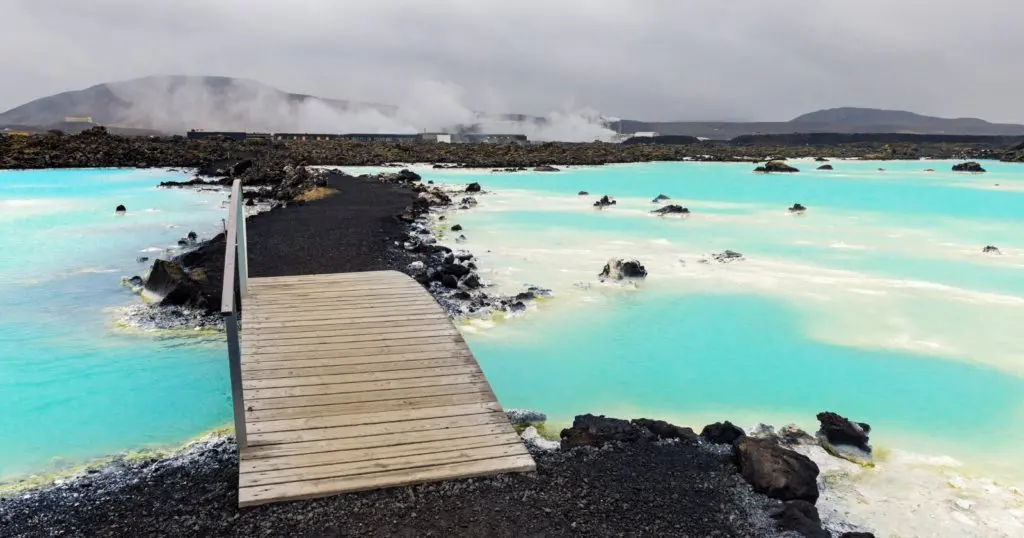
Iceland's most famous attraction was never designed as a spa. The Blue Lagoon, which draws well over a million visitors a year to its steaming, milky-blue water, started life in 1976 as runoff from the Svartsengi geothermal power plant on the Reykjanes Peninsula, southwest of Reykjavík.
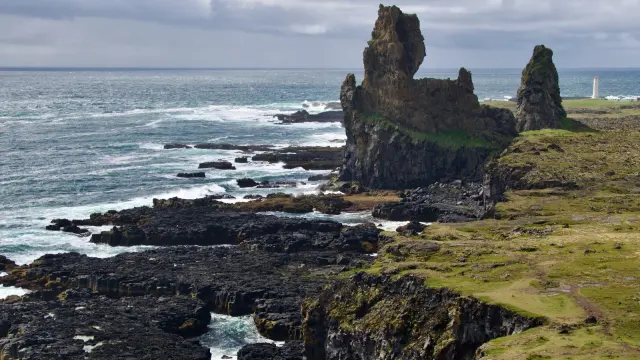
Svartsengi drills about two kilometres into rock heated by the Mid-Atlantic Ridge, where seawater and groundwater mingle into a scalding brine of roughly 240°C. Too salty and corrosive for radiators, the brine gives up its heat to warm freshwater and drive turbines, leaving the plant with tonnes of hot used fluid to get rid of. The plan was simple: dump it on the surrounding lava field — rock from an eruption in 1226 — and let it drain away through the cracks, as Icelandic rain always does.
The water had other ideas. The spent brine carried a heavy load of silica dissolved from the deep rock. As it cooled on the surface, the silica precipitated into a fine white mud that clogged every pore and fissure in the lava. In effect, the discharge was grouting its own basin shut. The more the plant released, the more watertight the pond became — and the suspended silica is what gives the water its unearthly blue-white colour. Engineers had accidentally built a self-sealing pool.
Locals mostly avoided the spreading effluent until 1981, when plant employee Valur Margeirsson, who had psoriasis, asked to bathe in the warm runoff. It helped, word spread through Iceland's psoriasis community, and by 1987 the first changing facilities appeared. Clinical studies later backed up the benefits of the silica and algae, and the site grew into a spa empire: treatment clinic, skincare line built on the same white mud, hotels, and eventually a purpose-built luxury lagoon with a Michelin-starred restaurant.
The plumbing never changed. The lagoon is still filled by the plant's discharge — nine million litres renewing every couple of days, held at a bath-friendly 37 to 40°C. The mud you scoop from underwater buckets is the same precipitate that sealed the basin. And the ground itself remains restless: the Reykjanes volcanic system woke in 2021 after eight centuries of quiet, and repeated eruptions near Grindavík have forced periodic evacuations, with lava flowing close enough that barriers were hastily thrown up to protect the plant.
Why does this matter to a traveller? Partly for the fun of knowing what you're actually floating in — engineered power plant runoff at premium prices — and partly because the story explains the lagoon's quirks: the colour, the mud, the steady refreshment of the water. It also sits near an active volcanic zone, so checking eruption updates before booking is genuinely sensible. If the main lagoon is closed or crowded, alternatives abound: local hot springs and municipal pools across Iceland offer a humbler version of the same geothermal magic, often for a fraction of the price.