A five-year-old holding hands in a 600-kilometre human chain doesn't grasp the politics. She grasps the feeling. That's exactly what happened to Ingrid Lukas in August 1989, when neighbours Vello and Helgi from the family's summer house in Viimsi took her along to the Baltic Way — the peaceful mass demonstration where roughly two million people across Estonia, Latvia and Lithuania joined hands to demand independence from the Soviet Union. She remembers no history that day. She remembers thousands of voices merging into one, and a sensation of unity and freedom that has shaped her life ever since.
Lukas, born in Estonia in 1984, left for Switzerland at ten when her mother remarried, settling in Winterthur. The contrast was stark: a child from a country whose highest point is 318 metres suddenly faced Swiss peaks three thousand metres tall. Then came harder years — she left home at fifteen, returned to Estonia alone, and by sixteen was living in Tallinn feeling profoundly isolated. In group settings her voice simply stopped working. What brought it back was a piano in the basement of the Tallinna Saksa Gümnaasium, where she sang Let It Be on repeat during school breaks until her own songs started to arrive. That basement, she says, was her first real home.
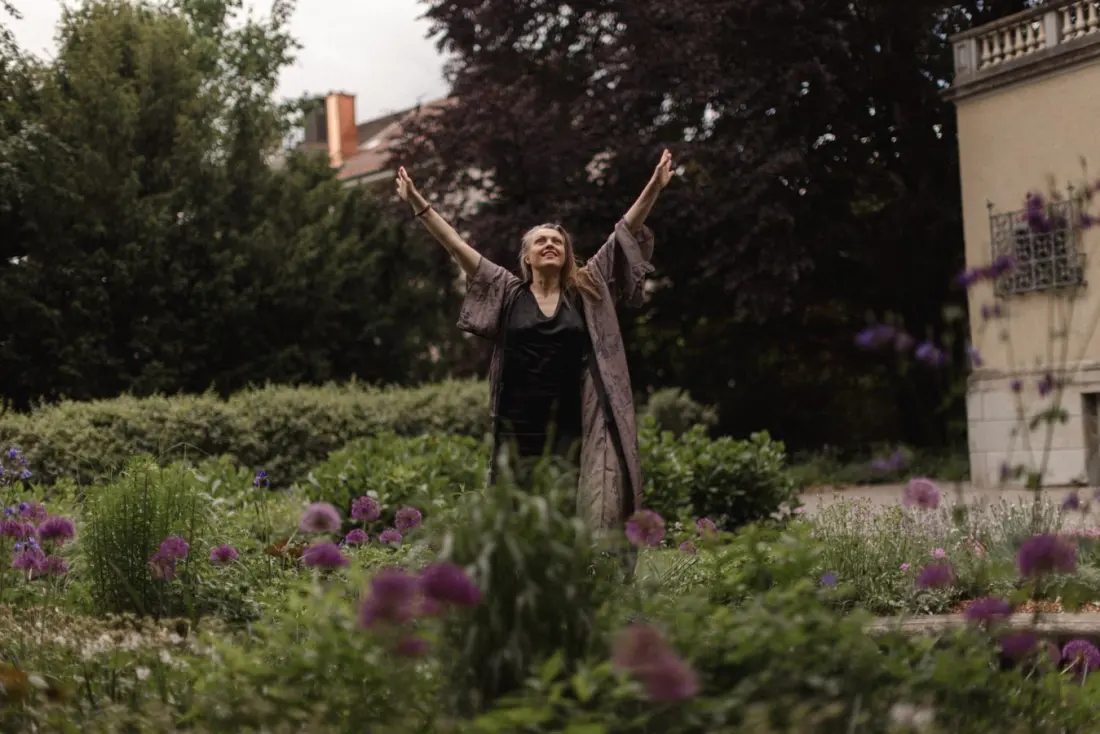
Today she's a singer-songwriter, pianist, voice coach and trained music therapist, with degrees from the Zurich and Berlin arts universities, and a new album a quarter-century in the making. Her musical roots run deep into Estonian soil: she's strongly influenced by regilaul, the ancient runo-song tradition where a lead voice sings and others respond. The songs look simple, but for her they're a doorway into something older — the rhythms of work, grief and celebration, and what she calls an ancient memory carried in the sound. She also cites a very Estonian word, avarus — spaciousness, an open-sky vastness — as the quality that lives inside her music and that she's never found anywhere else.
Her touchstones stretch from Arvo Pärt, whose music she's loved for over twenty years (they've spoken by phone, though never met), to Swiss pianist Nik Bärtsch, her long-time mentor, who taught her that showing up daily matters more than bursts of inspiration.
Why should a traveller care? Because Estonia is one of the few countries where singing genuinely changed history — the Singing Revolution of the late 1980s earned its name for a reason — and that heritage is still alive. The Estonian Song Festival grounds in Tallinn host mass choirs every five years, regilaul revivals fill village halls, and Pärt's minimalism echoes through local concert programmes. For anyone curious about a place where forest, silence and song are tangled together, Lukas's story is a good map. Her take on her two home countries rings true for visitors too: both Estonians and Swiss are quiet, resilient and close to nature. Strength, as she puts it, doesn't have to be loud.