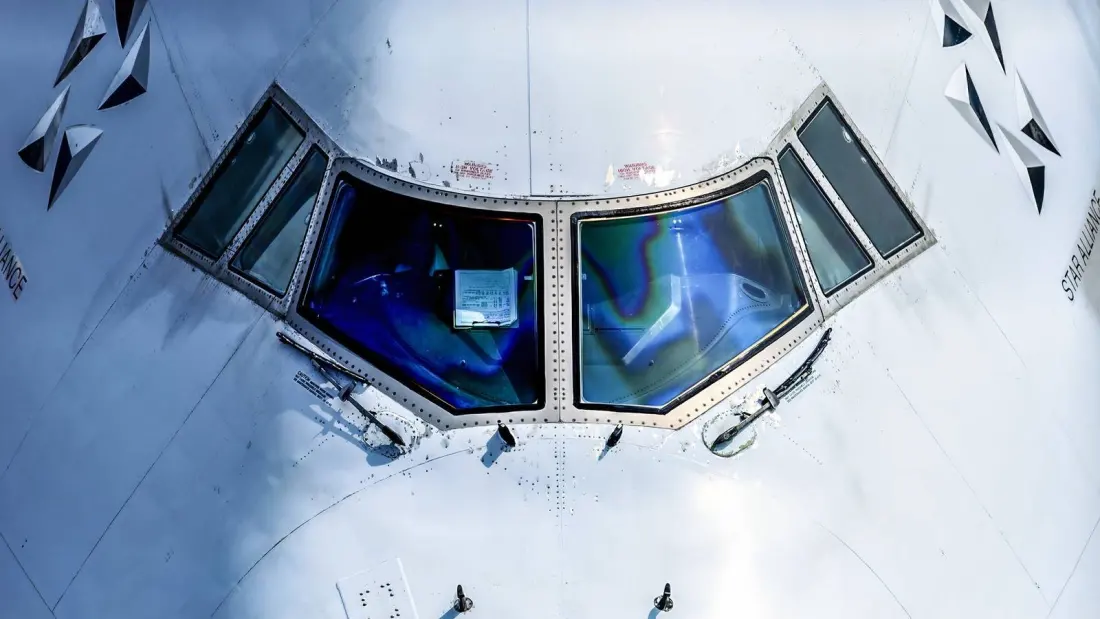
Four thrust levers, a cockpit perched high above the nose gear, and — on the earliest versions — a third crew member tucked behind the pilots. The Boeing 747 has always stood apart, and its flight deck tells the story better than anything else.
The original 747 entered airline service in 1970 with a crew of three: captain, first officer and flight engineer. The classics (747-100, -200 and -300) were packed with individual gauges and switches, and someone had to keep tabs on fuel, electrical and hydraulic systems while the two pilots flew, navigated and talked to air traffic control. That someone was the flight engineer, stationed behind the pilots at a dedicated systems panel. It was a role born of necessity — the workload of a 400-tonne aircraft couldn't comfortably be split two ways with the technology of the day.
Everything changed with the 747-400 in 1989. Boeing redesigned the flight deck around a two-pilot concept, swapping rows of mechanical instruments for electronic 'glass' displays and adding EICAS — an Engine Indication and Crew Alerting System that organised engine data and alerts into one integrated picture. The flight engineer's job didn't disappear so much as get absorbed: system monitoring moved into the pilots' line of sight, supported by automation. Crews still needed deep systems knowledge, but the third seat was gone for good.
The final passenger version, the 747-8, refined that formula further with liquid-crystal displays, an electronic checklist, an updated flight management system and a vertical situation display that visualises the aircraft's vertical flight profile. Same two-pilot philosophy, sharper tools.
But avionics are only half the story. Unlike modern twins such as the 777 or 787 Dreamliner, the 747 still uses a conventional, mechanically linked flight-control system with hydraulically powered surfaces — not full fly-by-wire. Add four engines to manage, split ailerons, triple-slotted flaps and sheer size, and the 747 becomes a genuinely different aeroplane to fly, not just a bigger one.
Then there's the view. The 747's cockpit sits high on the upper deck, far ahead of and above the landing gear, so pilots can't directly see where the wheels are. Taxiing, judging turns and lining up on a runway all depend on learned visual references rather than instinct — one reason pilots need dedicated type training even after years on other Boeings.
Why should a traveller care? Because the handful of 747s still flying passengers — Lufthansa, Korean Air and a few others — offer an increasingly rare experience shaped by this analog-era design: the upstairs cabin hump, the sense of a machine that predates full fly-by-wire. Book a 747 route and you're flying a bridge between two eras of aviation. Plans to fly one yourself: Lufthansa operates the 747-8 on select long-haul routes including Frankfurt to New York JFK, while Korean Air flies the type on Asian and transpacific routes.
Original source: Simple Flying