The Piolets d'Or — mountaineering's most coveted award — wrapped its 2026 edition in the French Alps, and behind the ceremonies sat some genuinely interesting arguments about the future of the sport.
The action unfolded around Saint-Christophe-en-Oisans, deep in the Ecrins Massif, with the main ceremony held in nearby Burg d'Oisans. Among those honoured: Nicolas Jean, who climbed Jannu East with Benjamin Vedrines, the full teams behind first ascents on Ultar Sar, Aikache Chokk and Jerupaja Grande, and living legend Peter Habeler, 84, who took a lifetime achievement award.
How does the judging actually work? Organiser Christian Trommsdorf explained that jurors sift through a "Big List" of the year's standout climbs, compiled by American Alpine Journal veteran Lindsay Griffin and the UK's Alpine Club. From there they privately shortlist and vote — this year, the winners emerged on the first ballot. One wrinkle: some climbers publicise being on the Big List as a "nomination," which organisers say it isn't. Still, the jury has no plans to publish its shortlist.
The liveliest debate concerned drones. Vedrines and Jean used them to scout their Jannu route, verify the true summit, and film the ridge traverse — though the machines failed on a key hidden section. Most of the winners treated drones as inevitable kit, comparable to satphones or crampons, provided teams are transparent about how they used them. Not everyone agreed: British jurist Paul Ramsden, holder of a record five Piolets d'Or, argues drones erode the uncertainty that defines pure alpine style. He uses no drones, trackers, or even satphones.
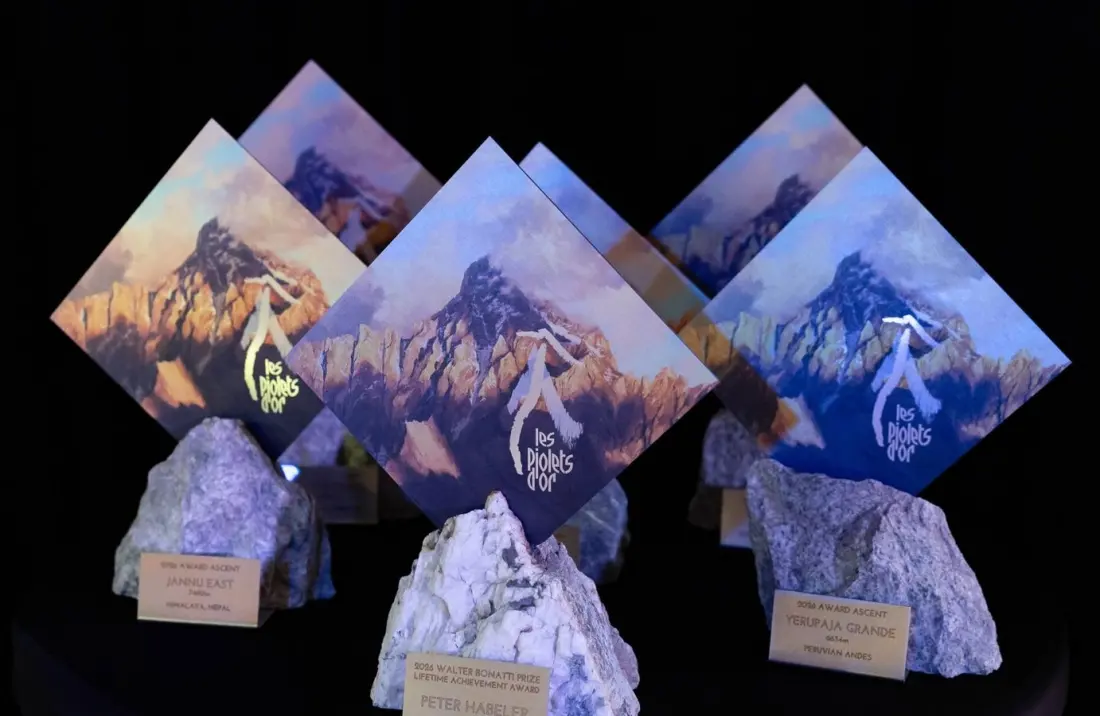
Expansion may be coming too. Trommsdorf floated dedicated awards for the best rock climb and best ski descent, building on a performance category tested this year — a category that included the 2025 Everest ski descents, both heavily supported and one oxygen-assisted. The female award went to Typhaine Duperier and Boris Langenstein for an alpine-style climb and ski descent of Nanga Parbat's Schell route. Open questions remain: should a supported, heli-assisted ski descent ever compete with a self-powered one, and where does rock climbing end and alpinism begin on high, dry faces? Even the trophy is evolving — no actual ice axe, but a plaque depicting La Meige, mounted on flood-damaged stone from nearby La Berarde.
Why should a traveller care? If you're drawn to the Alps beyond the lifts and luges, this corner of the Oisans valley is where climbing history gets made and argued over — and next year the event returns here, likely in late summer, to mark 150 years since the first ascent of La Meige. Organisers hope to grow it into a full international mountain festival, which could make it a genuinely compelling time to visit the Ecrins.
Story via ExplorersWeb.