Long before fancy-dress parties and plastic pumpkins, there was Samhain — the Celtic festival marking the end of harvest and the start of winter, when the veil between this world and the Otherworld was said to be at its thinnest. Costumes were worn to hide from wandering spirits and turnips, not pumpkins, were carved into lanterns. Irish emigrants carried those customs to America, where they morphed into the Halloween we know now. This autumn, Ireland's Midlands — arguably the birthplace of it all — has a new way to experience the original: the Samhain in the Heartlands trail, a self-guided route of 43 cultural stops spread across roughly 110km.
Start at the Hill of Uisneach in County Westmeath, a 182m-high mound of Neolithic and Bronze Age monuments. Local guides like historian Ruth Illingworth walk visitors past holy wells and solitary hawthorn trees — 'fairy trees' in folklore, believed to be thresholds to the Otherworld and home of the Tuatha Dé Danann, the gods of pre-Christian Ireland. The hill's centrepiece is the Catstone, a six-metre-wide, 30-tonne limestone boulder said to mark Ireland's symbolic centre and the resting place of Ériu, the goddess who gave the country its Irish name, Éire. Her willow sculpture now crowns the hilltop cairn known as St Patrick's Bed.
Mythology seeps into the landscape everywhere here. Ireland's 45,000 ringforts — 'fairy forts' — were attributed to the aos sí, beings of the Otherworld, and generations of farmers avoided disturbing them. That superstition left the Midlands dotted with untouched clumps of hawthorn, folklore preserved by mere bad luck.
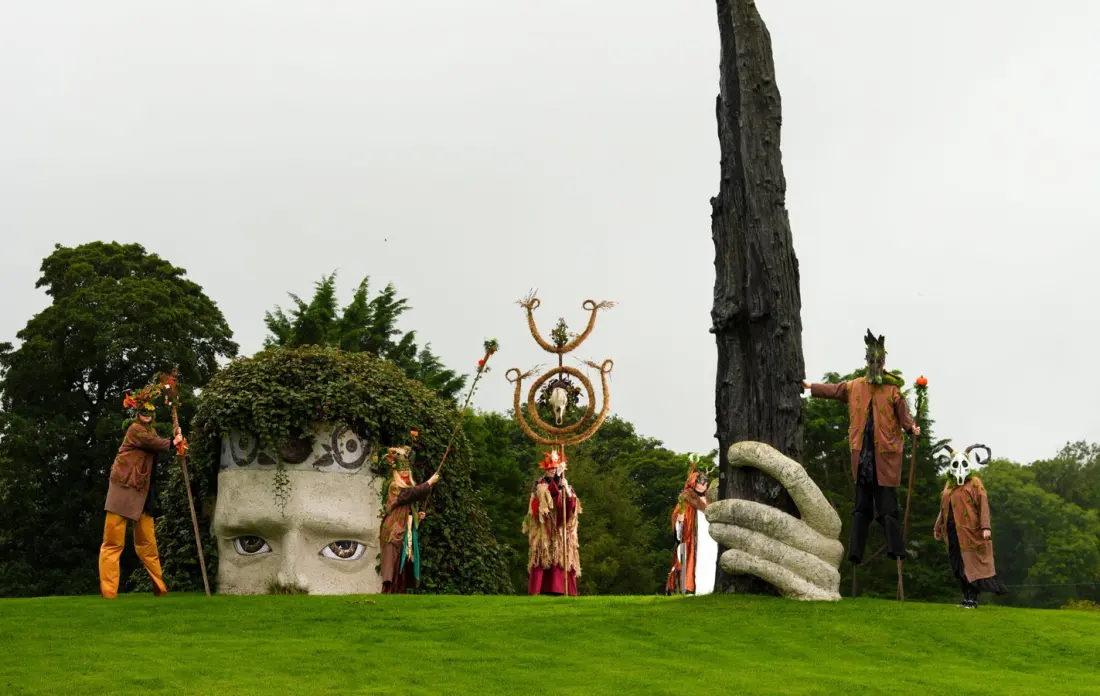
Drive west to Dún na Sí Amenity & Heritage Park near Moate, where a sculpture of the god-king Lugh brandishes a spear carved from 4,000-year-old bog oak, facing Ériu across the countryside. The park reconstructs a portal tomb, stone circle and ringfort — and has rescued donkeys. At Halloween it hosts the Spooktacular Summoning, an evening of theatrical folklore storytelling.
Further north-west, about 72km away, lies Rathcroghan, ancient seat of the kings of Connacht, ringed by more than 240 archaeological monuments. Its creepiest site is Oweynagat, the Cave of Cats — fabled as an entrance to the Otherworld and branded Ireland's 'gate to hell' by Christian scribes. It's currently closed to visitors due to naturally elevated carbon dioxide levels, but the Rathcroghan Visitor Centre in Tulsk runs guided tours of the wider complex.
The trail isn't linear; you can plot your own route over a few days. A highlight is the 43km Old Rail Trail, a traffic-free greenway from Athlone Castle towards Mullingar that passes Dún na Sí and skirts Uisneach — ideal for cycling through farmland and peat bog, with pit stops like Jack's Stop in Streamstown's restored station house for soup and apple pie.
For anyone who likes their holidays with a side of myth, atmosphere and quiet backroads rather than crowds, the Midlands at Samhain is hard to beat — especially around An Tairseach: The Gathering at Uisneach, two days of bonfires, music and storytelling marking winter's threshold.