
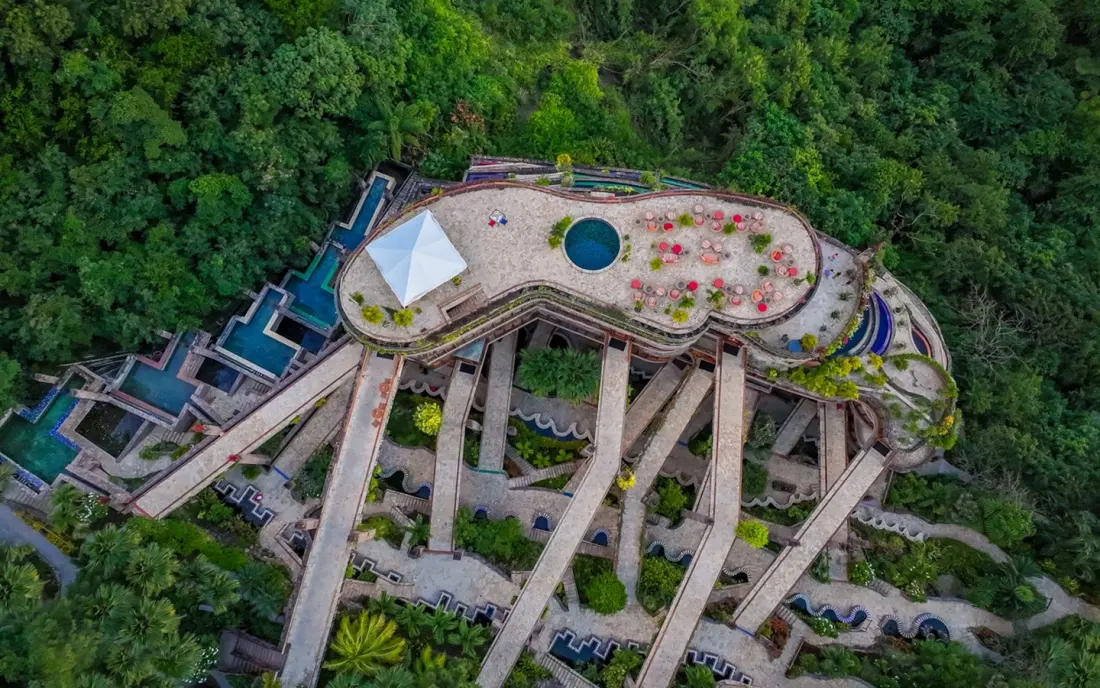
Jade Mountain in St Lucia is famous for one radical design choice: its 29 suites, called sanctuaries, have no fourth wall. No glass, no screen — just an open edge looking out over the rainforest to the Pitons, the island's twin volcanic peaks. Each sanctuary is a freestanding structure reached by its own stone bridge, with a private infinity pool and nothing separating the bedroom from the treetops.
The story behind it is as unusual as the architecture. Architect Nick Troubetzkoy arrived in St Lucia in the 1970s and never left, buying the small Anse Chastanet guesthouse in 1974 with just 14 rooms. He expanded it over decades into a 49-room resort on a 600-acre estate with two beaches on the south-west coast. Jade Mountain came later as an evolution of the same idea, deliberately built without a master plan so it could grow organically around the mountain. Troubetzkoy died in late 2024, and his wife Karolin and son Yasha now run both properties as a genuine family business.
The building itself is thoroughly local. Volcanic rock excavated during construction went straight back into the structure, pillars are indigenous tropical hardwood, and the floors are locally quarried limestone — chosen partly because it stays slip-resistant around open water. More than 500 St Lucians, many from nearby Soufrière, built Jade Mountain by hand. Rooms have no televisions, clocks or telephones, a deliberate push to disconnect.
Sustainability runs deep here too. Jade Mountain was the first Caribbean hotel to earn LEED Gold certification, and the resorts run coral reef restoration projects guests can join in person, plus reforestation with native species and a push against single-use plastics. The pair won the Caribbean Sustainable Tourism Award and a Lifetime Achievement Award in 2023. There's also an organic farm supplying the kitchens and a chocolate laboratory working with local cacao — guests can take a chocolate-making course on site. The family is one of the island's largest private employers, with several hundred full-time staff.
Who is this for? Not anyone wanting an air-conditioned white box with a TV. This is for travellers who want immersion — waking to wildlife at dawn, tub views of the Pitons, and food grown metres from the table. Sister property Anse Chastanet offers a more colourful, art-filled, generally gentler-priced take on the same philosophy, and staying at both gives you the full picture of a fifty-year project that's still the real thing.