Kazakhstan may not be the first country that comes to mind for Stone Age archaeology, but that is changing fast. At a symposium in Astana marking the 35th anniversary of the Margulan Institute of Archaeology, more than 150 researchers gathered to take stock of a discipline that has quietly made a qualitative leap in the past decade or two — and caves are at the centre of it.
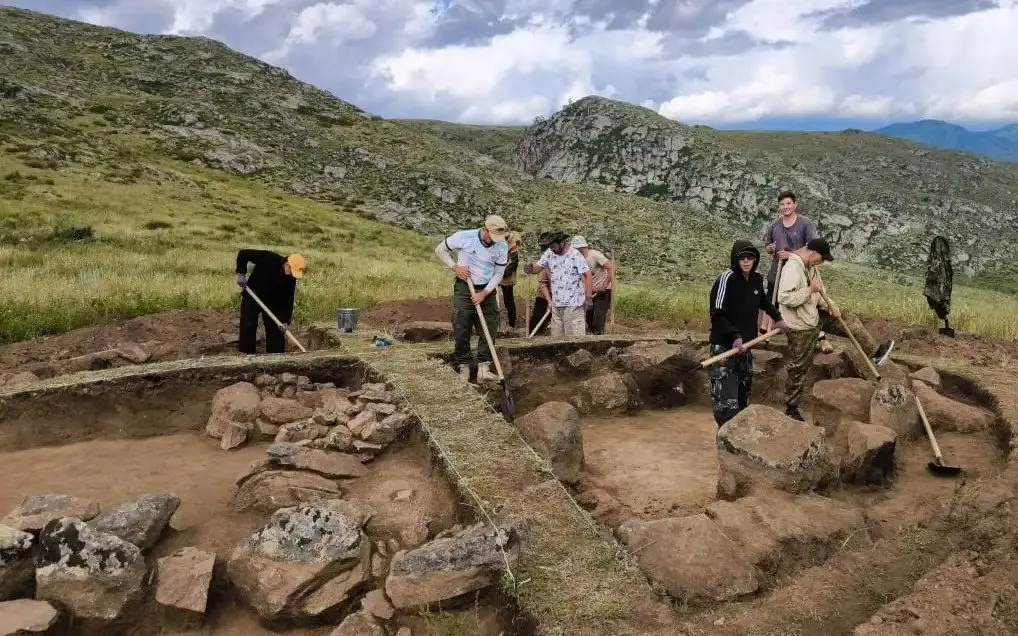
The focus is on two sites in the Karatau range of southern Kazakhstan: Tuttybulaq 1 and Aqtogai. Unlike open-air digs, caves preserve organic material and even ancient DNA in their sediments, meaning researchers can identify which humans or extinct relatives once sheltered there without finding a single bone. Abay Namen of Nazarbayev University, who leads work at the sites, is studying how people adapted to climate instability across the last glacial cycle, roughly 115,000 to 11,700 years ago.
The bigger picture is equally striking. Stratified Upper Paleolithic sites such as Rakhat, Uzynagash and Maibulak have established that modern humans settled Kazakhstan between 40,000 and 30,000 years ago. International collaboration — including with the Russian Academy of Sciences — has identified an entirely new archaeological culture, the Tian Shan Aurignacian, in the Zhetysu region. Six cultural layers have now been dated at Shiderty-3 in the northeast, and Kukentau stands as the country's earliest known Neolithic burial.
A possible Kazakh-French mission with France's CNRS could soon extend cave research from the Stone Age right through the Bronze Age. And the science goes far beyond digging: around 800 samples are being prepped for paleogenetic analysis, zooarchaeological collections from 123 sites document ancient economies, and the institute produced over 150 3D scans in 2024 while digitising roughly 3,800 old excavation reports.
The story doesn't stop in prehistory. Work at Bronze Age sites like Taldysai near Zhezkazgan has reconstructed ancient copper smelting, while Akmaya in central Kazakhstan preserves a full metallurgical complex with furnaces and chimneys. Saka-era finds at Berel and Shilikti reveal early nomadic art and burial practices — Berel's preserved organics even show woodworking, felt and leather techniques — and medieval cities such as Otyrar, Sauran and Taraz are refining what we know about Silk Road urban planning, irrigation and coinage.
For travellers, this is a reason to look at Kazakhstan differently. The places named here span the country — the Karatau hills and Zhetysu in the south, the steppe of Ulytau, the mountain-fringed east around Berel, and the Silk Road towns of the Turkistan Region — offering a rare chance to see archaeology in real time, in a country still early in developing its heritage tourism. Museums in Astana and Almaty, plus the National Museum's involvement in current fieldwork, make the connections tangible even if the dig sites themselves take effort to reach. Anyone drawn to off-the-beaten-path history should keep an eye on this story as it unfolds.