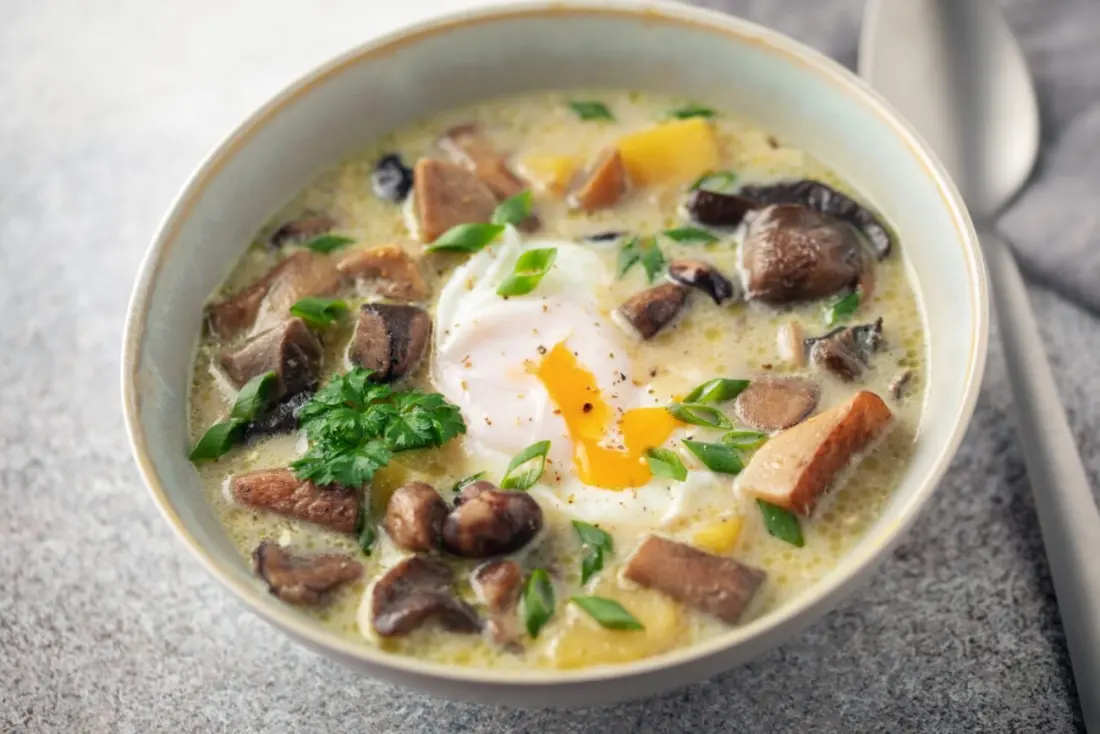
Ask a Czech food obsessive to pick the country's greatest soup and you won't get a long pause. Lukáš Hejlík — food blogger, actor and presenter who has covered Czech cuisine for nearly 25 years and now tours the whole country with his daughter on the Netflix show Czech It Out — doesn't hesitate: it's kulajda, pronounced KOO-lye-dah.
Unlike much of the Czech culinary canon, which drifted down from Vienna, kulajda came out of the mountains of South Bohemia. It's a humble thing on paper: a vegetable stock perfumed with dill, potatoes, mushrooms and caraway, finished with cream and crowned with a poached egg and more fresh dill. What lifts it, Hejlík says, is the tension between sweetness and acidity — the creamy base against a sour twinge. Older families, he recalls, sometimes got that sourness from milk that had just turned. Today it's usually vinegar or a splash of soured cream doing the job more predictably.
The soup matters culturally, too. It's a fixture of South Bohemian taverns and rural guesthouses, the kind of dish that shows up in village canteens rather than glossy Prague bistro menus — though plenty of Prague restaurants serving traditional food keep it on rotation. Travellers who spent time in the Czech Republic tend to remember it vividly; the writer behind this piece lived in Prague as an English teacher in the late 2000s and counts Czech soups among their strongest food memories, partly because a Californian encountering a real Central European winter learns quickly what a bowl of hot soup is worth.
For visitors, kulajda is an easy entry point into Czech cooking beyond the goulash-and-beer clichés. It's vegetarian-friendly (check the stock), cheap by restaurant standards, and filling enough to count as lunch on a cold day of castle-hopping. Look for it written as 'kulajda' or 'kulajda polévka' on menus, especially in South Bohemia around Český Krumlov, Třeboň and the villages along the Blanice river where it originated. Recipes vary — some add a vinegary kick, others keep it milder — so ordering it twice in different towns is a legitimate holiday activity.
Anyone planning a Czech trip with a food angle should treat it as a checklist item: one bowl in a village hospoda, ideally with dark bread and a local pilsner alongside. And if you want a guide to the whole cuisine, Hejlík's Netflix series doubles as a ready-made eating itinerary.