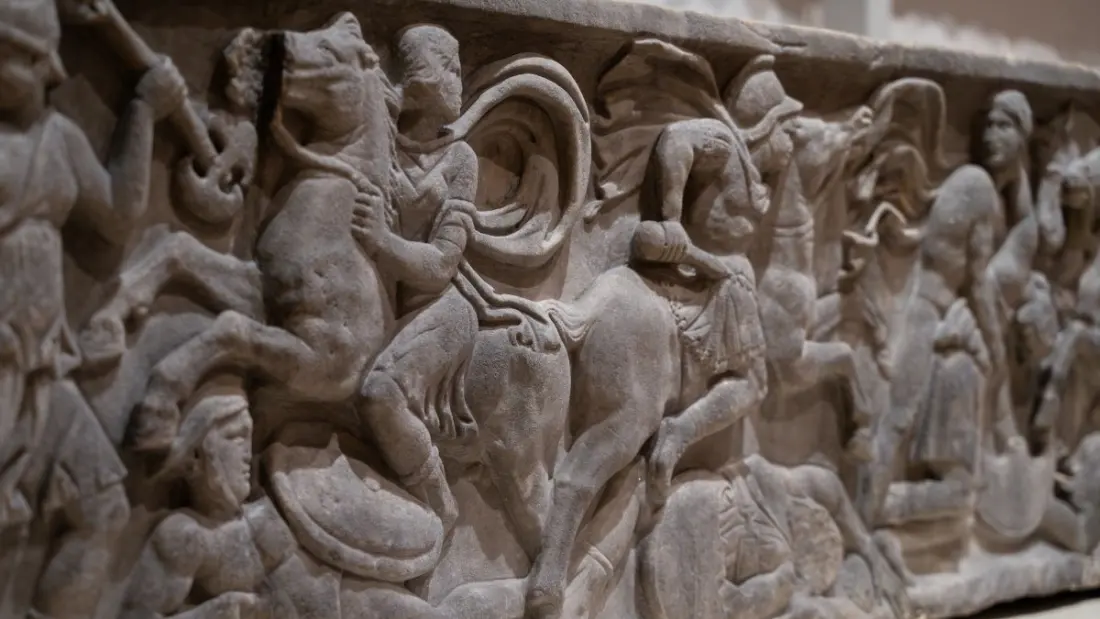
A 1,800-year-old Roman sarcophagus carved with scenes of Amazons battling Greek soldiers is now the star attraction at a brand-new museum in western Türkiye. The Kütahya Archaeology and Mining Museum opened its doors on 30 September, pulling together 3,300 artifacts from a much larger collection of more than 62,000 pieces held in the province.
The Amazon Sarcophagus, dated to around A.D. 160, is the headline piece, but it has company. The galleries also hold figurines and coins from the ancient city of Aizanoi, whose temple of Zeus counts among the best preserved in Anatolia and remains one of the region's most rewarding day trips.
Kütahya is a natural home for this kind of institution. The city has been a centre of Turkish ceramics for centuries, and the new complex celebrates that alongside its archaeology. Displays trace pottery from the Seljuk era right through to the present, with a heavy focus on works from the 19th and early 20th centuries. The ceramics museum that had operated in the city since 1999 has moved into the new complex, a shift that nearly doubled the exhibition space available.
Museum director Sevgi Gürdal frames the venue as a single stop for the region's three identities: archaeological heritage, traditional craft and mining history. The mining element is not a gimmick — Kütahya's wider province includes significant mining activity, and weaving that story into an archaeology museum gives visitors context for how the region developed.
For travellers, the opening adds a solid anchor to a part of Türkiye that most itineraries skip. Kütahya sits east of İzmir and south of Eskişehir, and pairs naturally with Aizanoi, about an hour away near the town of Çavdarhisar. The temple of Zeus there is strikingly intact, and you can wander the site without the crowds you'd meet at Ephesus. Combine the two — a morning at the museum, an afternoon among Roman ruins — and you get a compact picture of Anatolia's ancient and artisanal layers in a single day.
Who is this for? Anyone drawn to archaeology beyond the marquee sites, pottery enthusiasts who want to see where Turkish ceramics live and breathe, and road-trippers crossing central-western Anatolia. It's also a good rainy-day option if you're based in Eskişehir or Kütahya for thermal springs — the region's hot springs are another reason people pass through.
Practical notes: the museum opened recently, so expect fresh exhibits and full access to the doubled gallery space. If ceramics are your thing, the local workshops still produce the distinctive Kütahya style, and pieces make far better souvenirs than anything mass-produced. Check opening hours locally before setting out, as newly opened provincial museums sometimes adjust schedules in their first months.
Kütahya won't replace Istanbul or Cappadocia on a first-timer's list, and it shouldn't. But for a second or third trip to Türkiye — or an overland route across Anatolia — a museum that stacks Roman sarcophagi, Aizanoi coins and five centuries of pottery under one roof is a genuinely good reason to stop here.