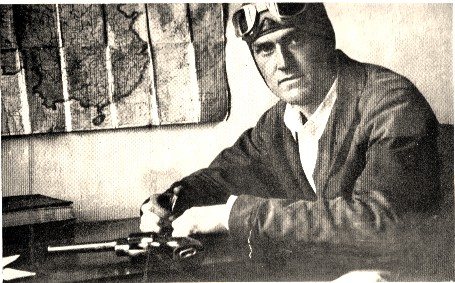
Leonard Francis Clark lived a life that reads like pulp adventure fiction — and that may be exactly the problem. Born in British Columbia in 1907 and raised in California, Clark spent the 1930s through the 1950s collecting expeditions: Borneo, the South China Sea, wartime China, Tibet, and the Peruvian Amazon. He died in Venezuela in 1957, and today he's almost forgotten. A fresh look at his record suggests the obscurity is deserved.
Most of what we know about Clark comes from Clark himself, always a warning sign. His 1938 National Geographic article on Hainan's Li people claimed he was the first outsider to enter 47 villages — while a contemporaneous newspaper account, sourced from his expedition partner Nicol Smith, credited Smith with being the first Westerner to penetrate the interior. Clark also claimed many local men stood six feet tall, a detail matching stock characters from pulp magazines rather than the region's actual demographics.
The war years are harder to pin down but more credible. Working for the OSS, the CIA's forerunner, Clark organised guerrilla activity and intelligence networks along the China-Burma-India corridor and worked alongside General Dai Li, the notorious Nationalist security chief. In 1949 he led a well-funded expedition into Tibet, where he claimed to have surveyed the peak Amne Machin at 9,040 metres — nearly a kilometre higher than Everest. Cartographer Bradford Washburn and the Alpine Journal dismantled the claim, calling his photographic evidence about as unconvincing as could be imagined. The expedition's real purpose appears to have been mapping an escape route into Tibet for the anti-communist warlord Ma Bufang, whose forces were pushed out of Qinghai by the PLA months later.
Then things got genuinely strange. In Canton shortly afterwards, a night of drinking ended with two fellow Allied intelligence men dead from gunshots and Clark wounded and jailed on manslaughter charges. The State Department, prompted by former OSS head William Donovan, got him out before the city fell to the Communists.
His next act was a hunt for El Dorado in the Peruvian Amazon, supposedly guided by an old parchment map. His book The Rivers Ran East is a parade of impossibilities: venom-spitting snakes that don't exist in South America, 227-kilogram boars, 12-metre pythons, and a secret London-based El Dorado society with no trace outside the book. What he actually found, by his own telling, was a group of Chicham people panning gold.
So why does this matter to travellers? Clark is a case study in reading adventure writing critically — the Amazon, Tibet, and Hainan attract storytellers as much as scientists, and vivid travelogues are not field data. His books are entertaining period pieces; just don't take the maps or measurements as gospel.