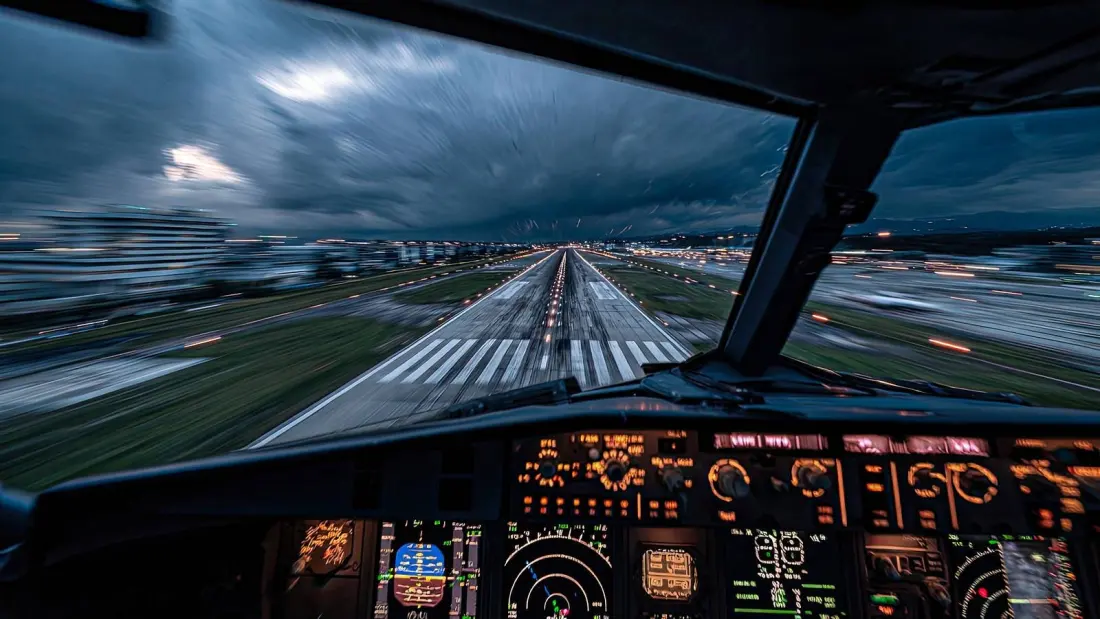
Next time your plane lands in a downpour and brakes hard without sliding, there's a good chance the runway surface is doing half the work. Many major runways around the world are cut with shallow grooves running across the pavement — channels that give rainwater somewhere to escape from under the tyres. Without them, a jet landing at speed can hydroplane: the tyres ride up on a film of water, braking fades, and steering becomes unreliable.
The idea was largely pioneered in the United States. NASA's Wallops research runway ran nearly 200 braking tests using a McDonnell Douglas F-4D Phantom II fighter and a four-engine Convair 990 airliner, showing that grooves dramatically improved stopping power on wet, flooded and slushy surfaces. Early experiments trialled square, V-shaped and trapezoidal cuts before the FAA standardised on straight transverse grooves. Today's FAA spec calls for grooves roughly 6.4 mm wide and deep, spaced about 38 mm apart. The FAA's landmark 1997 advisory circular made grooving a priority for every runway serving or expecting turbojet aircraft.
That strong US stance explains why grooving is nearly universal at American commercial airports — and why it's patchier elsewhere. ICAO recognises grooving as a way to improve wet-runway braking but stops short of mandating it. Canada left it optional for years; Ottawa International only became the country's first grooved airport in 2013. China and France lean on alternatives like stone mastic asphalt and textured pavements, while porous asphalt overlays, wire-combed concrete and smart runway gradients can achieve similar drainage effects.
Grooving isn't a free win, either. Tyre rubber packs into the grooves at touchdown zones and needs regular clearing, the cutting process can damage pavement, and in dry climates — think Arizona, Egypt or Saudi Arabia — the benefits barely justify the cost, though sand buildup and occasional flash floods complicate the picture. Small general aviation fields usually skip grooving altogether: light aircraft are less prone to hydroplaning and low traffic rarely justifies the expense. Ironically, small planes are quite vulnerable to skidding since many lack anti-skid brakes, so pilots there rely more on technique than pavement design.
The safety case is real. When Miami Air International flight 293, a Boeing 737, overran a wet, ungrooved Navy runway at Jacksonville in 2019 and ended up in the St. Johns River, the NTSB cited 'an extreme loss of braking friction due to heavy rain and the water depth on the ungrooved runway, which resulted in viscous hydroplaning.' Similar overruns have occurred at Kingston (American Airlines, 2009), Chicago (Southwest, 2011) and Christchurch (Virgin Australia, 2015) on wet or damp ungrooved runways. No serious injuries in the Jacksonville case, but the pattern is clear.
For travellers, this is mostly reassuring background: on major commercial routes, the surface under your wheels has been engineered for exactly this scenario. It may also quietly explain why landing distances and go-arounds look different at smaller regional airports in heavy rain — a good reason to trust a crew that decides the weather isn't worth the attempt. Reported by Simple Flying.