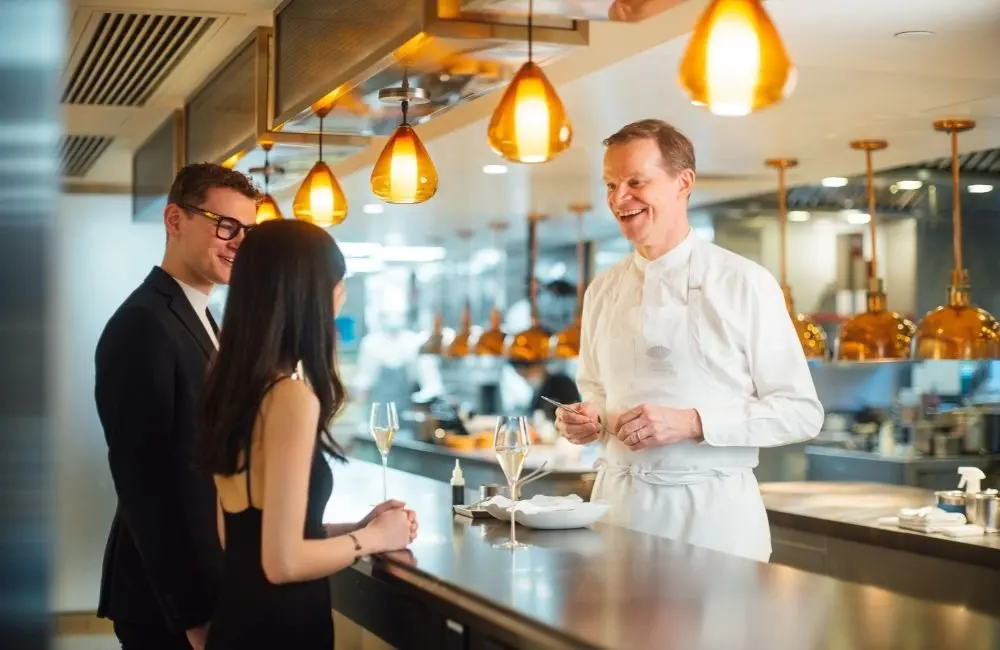
Luxury hotel dining has long been an afterthought: a restaurant downstairs because a hotel needs a restaurant downstairs. Mandarin Oriental is scrapping that logic. The group has renamed its entire food and drink operation "Restaurants, Bars & Experiences" (RB&E) and reframed each venue as a standalone draw with its own identity, audience and reason to exist — whether or not you're staying in the rooms upstairs.
Group director of RB&E Christian Gradnitzer frames it as a response to how people actually spend their evenings now. Guests aren't just booking a table; they're choosing an entire experience built from design, sound, atmosphere and storytelling, delivered by chefs, pastry chefs, sommeliers, bartenders and service teams as a single package. The group also plans to lean on technology and guest data to help teams anticipate demand and tailor the experience in real time.
The clearest example of the new thinking is the phased transformation of Mandarin Oriental, Hong Kong, which is being reworked around 14 distinct restaurant, bar and experience venues. In Mallorca, the forthcoming Mandarin Oriental Punta Negra will open with four restaurants — Leña, Matsuhisa, Sobretaula and Jacinta — positioned as integral to the resort rather than a conventional hotel dining collection.
The credentials behind the strategy are already strong. In Shenzhen, The Bay by Chef Fei holds two Michelin stars and OPUS by Chef Alessio Durante holds one, while Jiang by Chef Fei in Guangzhou retains two stars of its own. So this isn't a group building a restaurant empire from scratch — it's one restructuring an already-decorated portfolio so each venue can compete for attention on its own terms, and so its talent can collaborate across properties and build individual profiles.
Why should a traveller care? Because it changes how you might plan a trip. If a hotel group treats its venues as city anchors — places locals seek out, not just guests — then booking a table becomes a legitimate reason to choose that property, or even to fly somewhere. Expect more restaurant-first itineraries, more events and programming around the venues, and more competition among luxury brands to hire name chefs and build distinct concepts rather than interchangeable hotel dining rooms. For anyone who books hotels around where they want to eat and drink, Mandarin Oriental has just made that approach official policy.
The detail to watch is execution. Renaming a department is easy; making 14 Hong Kong venues feel genuinely distinct, and making a Mallorca resort a dining destination in a market full of them, is harder. But with Michelin-starred kitchens already in place and a stated ambition to tie each venue to its city's culture, the early signals are credible.