
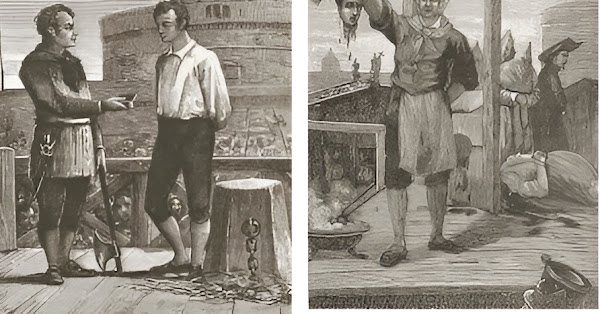
For almost seven decades, crossing the Ponte Sant'Angelo was bad news for someone in Rome. That's when Giovanni Battista Bugatti — better known by his nickname Mastro Titta — left the Vatican side of the Tiber, and locals instantly knew an execution was coming.
Bugatti was born in the Adriatic town of Senigallia in 1779 and took the job of official executioner for the Papal States at just seventeen. His first recorded work was in Foligno in March 1796, and he didn't retire until 1864, when Pope Pius IX pensioned him off at eighty-five. Across those 68 years he carried out 516 executions under six popes and the French occupation, making him the longest-serving executioner in papal history. His nickname came from the Roman dialect for "master of justice," and it stuck so firmly that Mastro Titta became the generic Roman word for any executioner.
What makes him fascinating is how un-monstrous he seems. Short and impeccably dressed, he lived an otherwise ordinary life in the Borgo district near St Peter's, attending church and supplementing his income by painting and selling umbrellas — many decorated with papal portraits and Roman scenes for the souvenir shops around the basilica. He kept a meticulous notebook recording every name, crime, date and method, and he referred to executions as "justices" rather than killings. He even offered snuff tobacco to the condemned moments before the act, apparently seeing himself as a public servant rather than a sadist. Tradition kept him out of central Rome unless duty called, which is why his river crossings functioned as the city's grimmest news alert.
His fame spread well beyond Italy thanks to travelling writers. Charles Dickens watched him work in 1845 and wrote about it at length in Pictures from Italy; Lord Byron mentioned him in letters home; the Roman poet Giuseppe Gioacchino Belli dedicated satirical sonnets to him, and a rather cheerful children's rhyme kept his name alive in the streets. Public executions drew big crowds at Piazza del Popolo and near Castel Sant'Angelo, where fathers reportedly slapped their sons' heads as the blade fell — a blunt lesson that the same fate awaited them if they strayed.
Bugatti used every punishment the Papal States allowed: hanging, beheading by axe, drawing and quartering, the mazzatello (a mallet blow to the head followed by a cut throat), and later the guillotine, which arrived with the Napoleonic era. Brutal as that sounds, it was standard for the age — he averaged only about seven or eight executions a year.
For visitors to Rome today, Mastro Titta is a strange thread tying together the Borgo's quiet lanes, the bridge over the Tiber and the city's darker past. His blood-stained scarlet hooded cloak is still displayed at Rome's Criminology Museum, a short walk from the streets he once called home — a fittingly macabre detour for anyone who likes their history with an edge.