
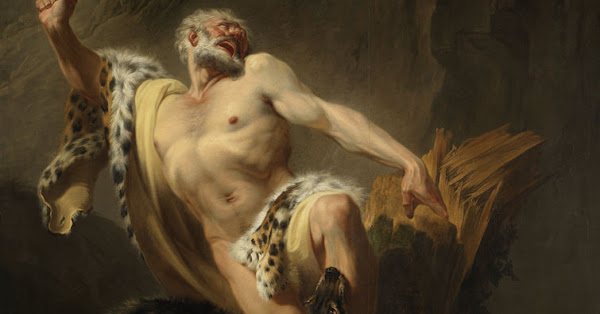
The strongest man of the ancient Greek world didn't fall in battle. He got his hand stuck in a tree stump and was eaten by wolves — at least, that's the story ancient writers loved to tell.
Milo of Croton was a real person, not just a legend. He came from Croton, a wealthy Greek colony on the toe of Italy, in what's now Calabria. The second-century AD travel writer Pausanias credits him with six Olympic wrestling crowns — one as a boy, five as a man — plus wins at the Pythian Games, and a failed bid at a seventh Olympic title, blocked by a younger wrestler named Timasitheus. Around 511 BC, according to the historian Diodorus Siculus, Milo led Croton's army against rival city Sybaris dressed as Heracles: lion skin, club and all. When your military look is 'mythical demigod', you've made it.
The strength legends piled up fast. The most famous has Milo training by carrying a calf every day; as it grew into a bull, so did his strength, until he could stroll a full-grown bull around a stadium before eating it. He could also hold a pomegranate so firmly no one could pry it from his hand — without bruising it — stand on a greased discus and shrug off everyone who tried to shove him off, and snap a cord around his forehead by simply flexing the veins in his head.
Then came the ending that sealed his fame. Pausanias, writing some 700 years later, tells of Milo walking in the countryside when he met a villager splitting a tree stump with wedges. Ever the showman, Milo offered to tear the wood apart bare-handed instead. He jammed his fingers into the wedge-split crack and pulled — the wedges dropped out, the stump closed on his hands, and he was trapped. The villager left to fetch food; the wolves arrived first.
Ancient audiences passed this story around for centuries as a morality tale about overreach and arrogance. And honestly, that mix of hard fact and tall tale is part of the appeal: the medals were real, the death scene probably wasn't, and 2,500 years later we're still talking about both.
For travellers, the story is a good excuse to look past Calabria's beaches. Modern Crotone sits on the site of ancient Croton, with a compact old town, a hilltop castle (the Castello di Carlo V), and a reputation as one of southern Italy's least-visited, most affordable corners. There's even a local statue of Milo near the waterfront — flexing, naturally.
Who it's for: history-minded road-trippers working down the Ionian coast, anyone pairing Calabria with a Sila mountains detour, and travellers who like their sightseeing with a side of ancient gossip.