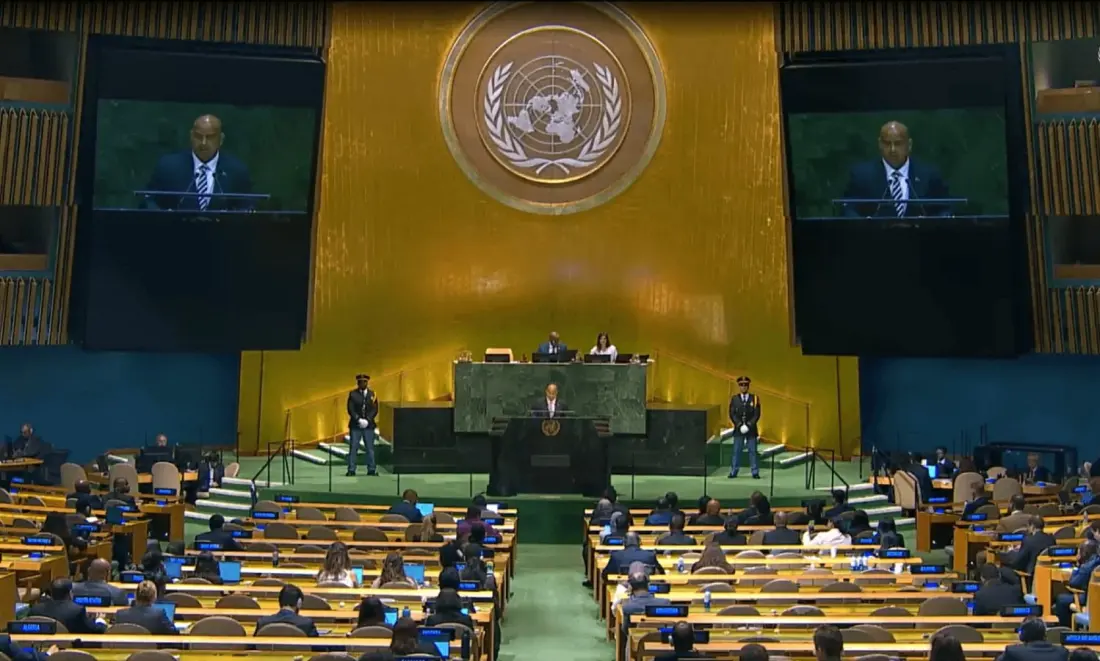
When the 12 Pacific Island countries that hold UN seats took the microphone at the General Assembly's General Debate in New York in late September, the speeches turned into a revealing snapshot of regional mood. Read together, they show a bloc increasingly confident about pushing its own agenda — and increasingly unwilling to be squeezed between the United States and China.
Climate and oceans stayed front and centre. Leaders welcomed the UN Declaration on Sea-Level Rise, adopted during the Debate, which affirms that rising seas should not cost a nation its statehood or sovereignty. Tuvalu's Prime Minister Feleti Teo, whose country has campaigned for the declaration for years, called it a monumental achievement. Speakers also promoted homegrown initiatives like the Pacific Resilience Facility and highlighted early support for the new high seas biodiversity agreement.
The loudest theme, though, was a rejection of geopolitical competition. Palau's President Surangel Whipps insisted the Pacific is a home, not a theatre for rivalry, while Nauru's President David Adeang declared his country would work with any partner that respects its sovereignty — and would not be made to choose sides. The number of Pacific speakers explicitly opposing power struggles jumped from four last year to nine this year. Notably, almost none named the US or China directly, and praise for traditional partners actually fell, with Japan and Germany mentioned more often than Washington, Beijing, Canberra or Wellington. Taiwan, by contrast, featured prominently in speeches from the Marshall Islands, Palau and Tuvalu.
Nauru delivered the odd one out. Speaking at the UN under its new name for the first time, it skipped climate change entirely and announced a withdrawal from the International Criminal Court — hours after Donald Trump urged nations to leave the court. Yet Nauru also joined Tuvalu and Vanuatu in criticising the US embargo on Cuba, a reminder that Pacific positions rarely fit tidy blocs. Elsewhere, West Papua human rights concerns were raised by the Marshall Islands, Solomon Islands and Vanuatu — a significant shift from last year, when no Pacific speaker mentioned it — while leaders paid warm tribute to outgoing UN Secretary-General António Guterres, a frequent visitor to the region.
Why should travellers care? This is the political weather over a region many visit for diving, sailing and island-hopping. A Pacific that insists on its own agency, prioritises climate resilience and ocean governance, and keeps rivalries at arm's length is generally good news for stability — and the region's diplomatic visibility often translates directly into tourism investment, flight routes and climate adaptation funding that shape the visitor experience. For anyone following Pacific affairs, the speeches also signal which alliances are warming: Taiwan's ties with its few Pacific allies, and Nauru's unpredictable streak, are worth watching.