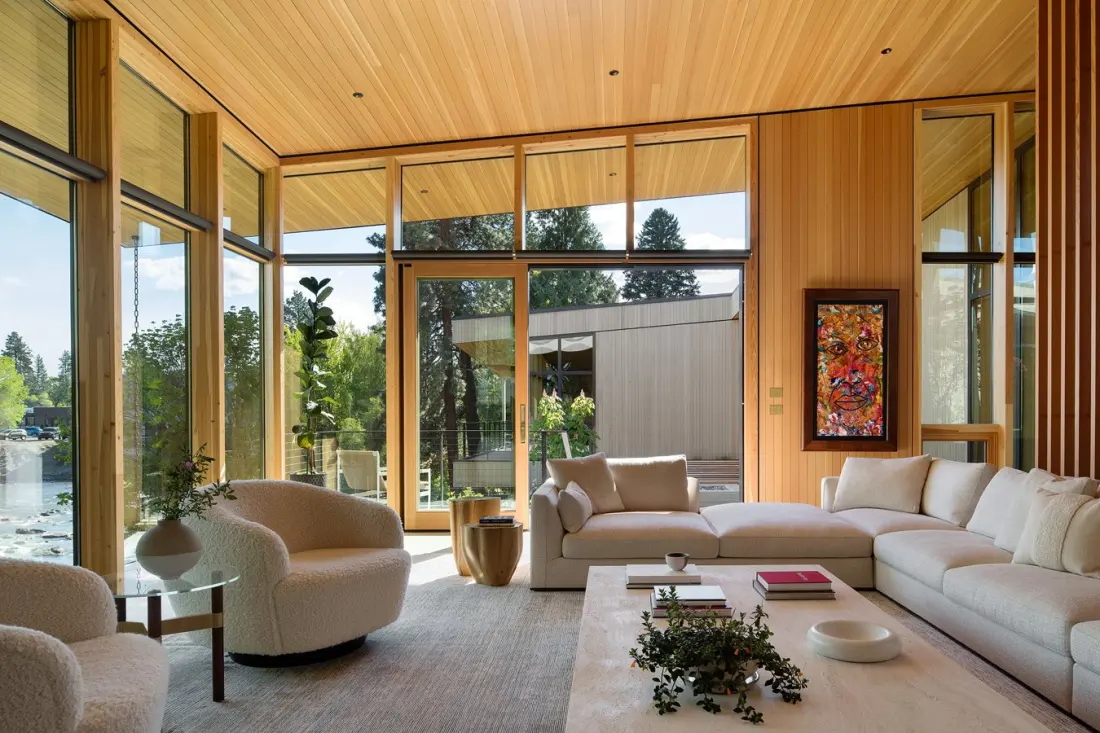
Right on a stretch of river rapids near a downtown in central Oregon, architecture firm Hacker has completed a 6,500-square-foot house that treats the high desert as a co-designer. Principal Corey Martin describes the site in geological terms — lava flows, basalt canyons, cinder cones in reds, blacks and buff tans — and says the goal was never to just sit on the landscape but to amplify it: the river's force, the industrial buildings across the water, the intensity of the desert light.
The clients, a retired couple whose adult children live nearby, asked for two seemingly opposite things: total immersion in nature and privacy from the neighbouring town. They also wanted a house that could handle big family celebrations, indoors and out. The design answers with a long, low linear form that traces the river, roof planes angled toward the sky, and courtyards that pull the terrain into the middle of the plan.
Arrival is deliberately theatrical. From the street you get a low-slung profile and shifting layered walls of board-formed concrete, punctuated by massive boulders in matte greys and oranges that echo the local rock. The path opens into an entry courtyard that swings your view toward the water, and a thick blackened-steel front door with a carved faceted slot marks the threshold. Inside, a soaring living room centres on a sculptural fireplace, with the kitchen wrapping around it — island plus a fireside lounge meant for gathering.
The most dramatic move is an eating nook with floor-to-ceiling glass that makes breakfast feel like hovering above the rapids. A central spine runs the length of the house, alternating north- and south-facing courtyards so the light and mood shift as you move — shadow to brightness, enclosure to openness. Off that spine: a fir-clad office, a river-facing gym, and a primary suite with a covered deck above the water and a daylight-flooded bathroom with a skylight. Two guest rooms share a fluted white-tile bath in the east wing. Outside there are two large terraces — one with a fire pit and built-in seating, the other set up for cooking and long dinners — plus a three-car garage, workshop and utility room rounding out the practical side.
Why should travellers care? Because central Oregon keeps proving it's one of the most quietly design-literate corners of the American West. Bend and its surroundings pair volcanic scenery — the Deschutes River, cinder cones, ponderosa forest — with a small city that has serious food, breweries and an architecture scene increasingly worth a look. A house like this doubles as a guidebook: it points you toward the river walks, the high-desert light at golden hour, and the way town and wilderness sit almost on top of each other here. If you're plotting a Pacific Northwest trip that skips the usual Portland-and-coast loop, this is a strong argument for pointing the car east toward the lava fields.
Sunset