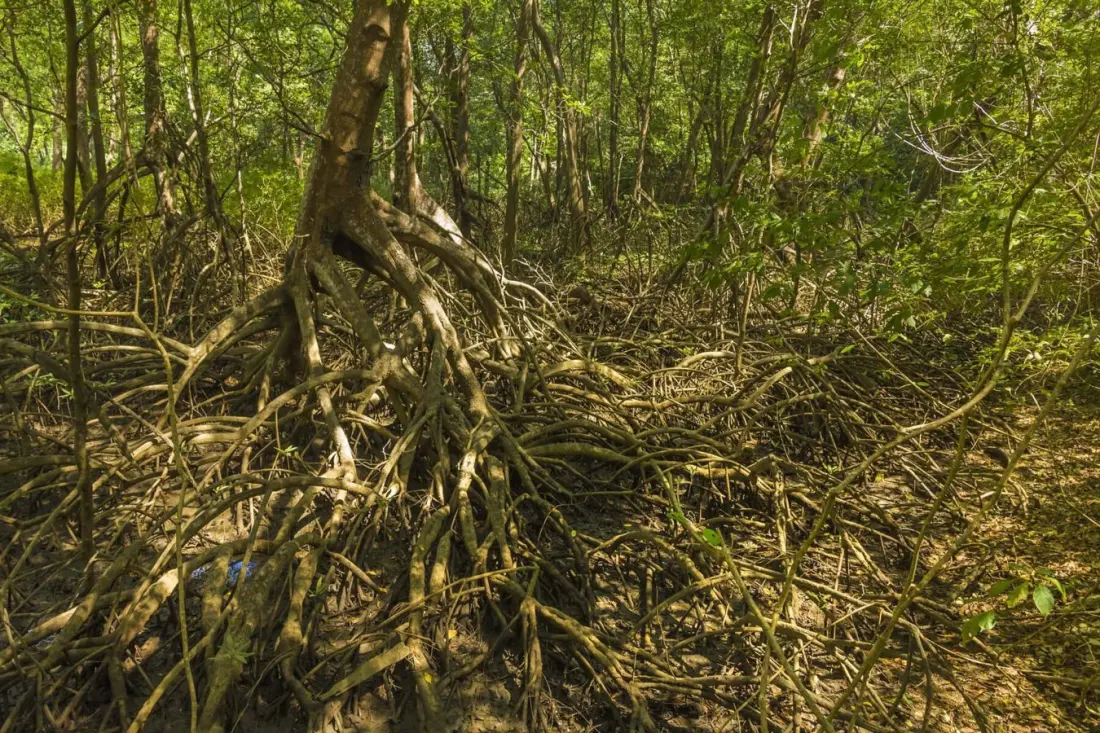
On Costa Rica's Pacific coast, the community of Playa Sámara is trying to undo something remarkable: more than three decades of damage to the mangrove wetland along the Río Lagarto. Their campaign has already stopped one major development, and now it's moving into a much harder phase — actually restoring what was lost.
The National System of Conservation Areas (SINAC), the country's environmental agency, is seeking court authorization to run field studies on two private properties in the Cangrejal area. The goal is to work out how far the mangrove originally extended, how deep the fill sits above the old wetland, and where its official boundaries should be drawn.
The scale of the problem is significant. SINAC estimates that over 300,000 cubic meters of fill were dumped in the area between 1980 and 1996, much of it during a tourism construction boom. Clearing that much material would take around 21,000 dump-truck trips. Full restoration is projected to cost roughly ₡179 million and stretch across about a decade — and it can't be rushed, because pulling out too much fill too fast would send sediment washing into the ocean and threaten nearby marine life.
Long-time residents remember what the area once was. Local Patrick McGoey describes how trees were cut and land filled to make way for tourism infrastructure, leaving sections of the former mangrove looking like open farmland. Juanita Castillo recalls when small-scale fishermen worked the wetland and sold their catch in the town of Nicoya, an income source for local families. Aerial imagery from the mid-20th century confirms that several hectares of mangrove stood where developers later built.
The fight got urgent in 2024, when the Vistas de Sámara project proposed 37 ten-story apartment towers with thousands of units, plus 333 condominium lots, right next to the wetland. A formal manifesto signed by 366 residents opposed it through the Municipality of Nicoya, and the developer eventually withdrew. Costa Rica's environmental authority, SETENA, then cancelled the project's environmental viability at the developer's request. Now the Coalition for Human Rights and the Environment (CODEHMA) has joined residents pressing for official demarcation and a proper restoration plan.
For travellers, this is a story worth knowing before visiting. Playa Sámara is a relaxed beach town in Guanacaste, popular with families and surfers, and the Río Lagarto estuary is part of what makes it appealing — mangroves support fish, birds and the marine life that draws people here in the first place. The community's message isn't anti-tourism; resident Javier Armijo puts it plainly: development is welcome, but it needs to match the sensitivity of the place. Choosing locally run tours, kayak trips through intact estuaries and responsible operators is a small way visitors can support exactly that kind of tourism.
The decade-long restoration hasn't started yet — it still needs judicial sign-off and funding — but Sámara has shown that a determined community can change what gets built on its coastline.
The Tico Times