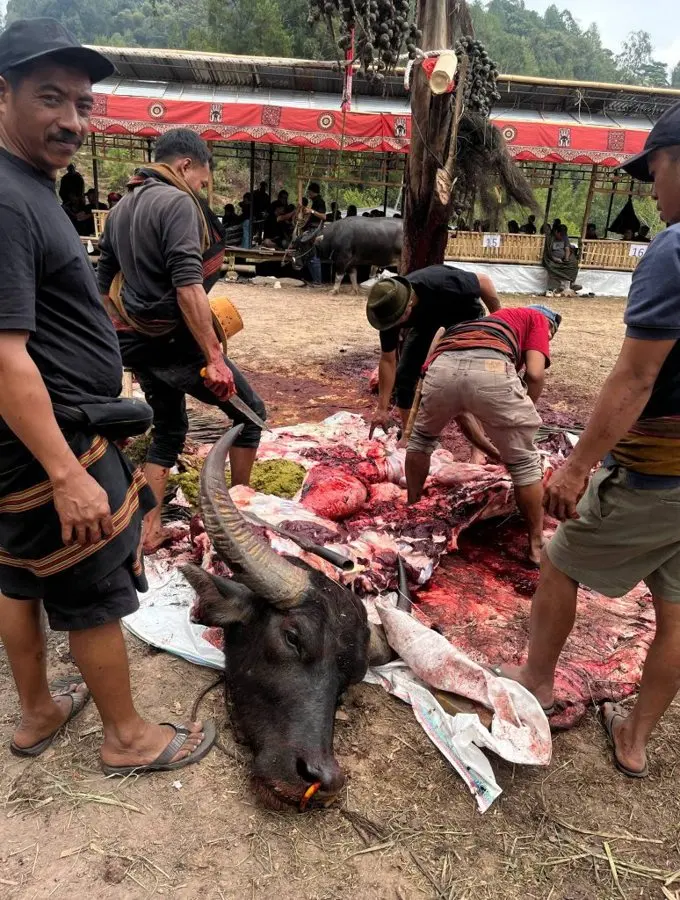
Ten hours overland from Makassar, deep in the hills of South Sulawesi, a funeral is underway. A butcher works through a line of bulls, an MC narrates the whole thing on a microphone, and a street food vendor sells bakso to the crowd. This is a Rambu Solo — the traditional funeral ceremony of the Toraja people, and one of the most striking cultural events in Southeast Asia.
The Toraja view death differently from most of the world. A deceased relative is often kept at home for months or even years, until the family has saved enough to hold a proper send-off. And "proper" can mean enormous: buffalo are sacrificed to guide the dead into the afterlife, and the number killed reflects the family's wealth and status. Ordinary buffalo run roughly $1,200–1,500, but prized specimens — one albino at a local market carried a $50,000 price tag — can be worth a fortune. Beyond the spiritual side, these ceremonies are very public displays of standing in the community.
The event itself is more organised than it first appears. Guests sit in numbered sections around the grounds, food circulates, and once the buffalo are slaughtered the meat is shared among attending families. The writer behind this account watched around ten bulls awaiting their turn, and describes the kills as far more brutal than expected. There's a genuine element of danger too: wounded animals sometimes break free, and spectators — warned by the MC through a translator — need to take cover. People do get injured at these events. Pigs often join the menu alongside the buffalo.
So how do you actually see one? These are funerals, not shows, so there's no fixed calendar. Most families hold ceremonies in the dry season, roughly June to September, with August your best statistical bet. Even then, independent travellers should expect a lot of asking around and driving between villages to find an event. Getting to Rantepao means flying into Makassar and connecting to an airport about an hour away, or taking the 10-hour sleeper bus overland — a scenic route you can break up with stops in Parepare or Enrekang, small towns with charm but little tourist infrastructure.
A word of honesty here: this is not an experience for everyone. The slaughtering is graphic and visceral, and anyone uncomfortable with that should think hard before going. But for travellers interested in living cultures rather than staged performances, few ceremonies anywhere offer this combination of spectacle, meaning and rawness — alongside Toraja's famous cliff burials and tongkonan houses, which make the region worth several days on their own. Young Pioneer Tours is currently weighing whether to add it to their lineup, and given their dark-tourism-friendly catalogue, that wouldn't be a surprise.
If you go, hire a local guide. Beyond translation — including those all-important safety warnings — a guide is what gets you invited to a family ceremony in the first place, and etiquette matters when you're attending someone's funeral, not an attraction.
Story via Young Pioneer Tours.